Share This

Sunday, June 7, 2026

Lower your high blood pressure in just 11 minutes

 USM researchers find that a simple hand exercise could help decrease high blood pressure


This isometric handgrip workout can be done anywhere and at any time, making it a useful adjunct intervention to help manage hypertension. — Pexels

A simple hand-squeezing exercise that takes just 11 minutes may offer Malaysians an easy and affordable way to lower blood pressure without gym memberships, expensive equipment or strenuous workouts.

Universiti Sains Malaysia (USM) Tun Abdullah Ahmad Badawi Cancer Centre researchers have discovered that a short session of isometric handgrip exercise significantly reduced blood pressure among participants with hypertension.

The study, published in the International Journal of Isokinetics and Exercise Science, involved 56 sedentary Malay men aged between 20 and 59 years old, with different resting blood pressure levels: normal, pre-hypertension, and Stage 1 and Stage 2 hypertension.

The researchers first measured each participant’s maximum handgrip strength using a hand dynamometer.

Participants were then instructed to perform four sets of two-minute handgrip contractions at 30% of their maximum strength, alternating hands  h one-minute rest intervals tween sets.

One hour after completing the session, the researchers observed significant reductions in both systolic and diastolic blood pressure, as well as mean arterial pressure.

Participants with Stage 1 hypertension experienced the greatest reduction in systolic blood pressure, recording an average decrease of 6.3mmHg after just one session.

Meanwhile, participants with Stage 2 hypertension showed the largest reduction in diastolic blood pressure.

This suggests that individuals with higher blood pressure may benefit the most from the intervention.

The researchers stressed that even modest reductions in blood pressure could produce major long-term health benefits.

Previous evidence shows that lowering blood pressure by just 2mmHg may reduce the risk of cardiovascular disease and stroke-related deaths.

Unlike jogging or aerobic exercise, isometric handgrip exercise involves sustained muscle contraction without major joint movement.

The researchers believe these repeated contractions may help improve blood vessel function and vascular regulation, although more studies are still needed to fully understand the underlying physiological mechanisms.

Because the exercise requires minimal movement and no equipment, the researchers believe it may be especially useful for busy working adults, elderly individuals and people who struggle to maintain conventional exercise routines.

While the exercise method was originally developed and tested in Western populations, the team successfully demonstrated that the same approach could also benefit Malaysians, particularly within the Malay population.

Lead researcher Associate Prof Dr Hazwani Ahmad Yusof said local validation is important because ethnic, genetic and lifestyle differences may influence how people respond to exercise interventions.

“Most previous studies on isometric handgrip exercise were conducted in Western populations.

“Our findings provide important early evidence that this simple intervention may also benefit the Malaysian population,” she said.

Despite the encouraging findings, the researchers emphasised that this exercise should not replace prescribed medication or professional medical treatment.

Instead, it should be viewed as a complementary lifestyle strategy that may support cardiovascular health alongside proper medical care.

The research team is now calling for larger and longer-term studies involving more diverse Malaysian populations, including women and older adults, to determine whether regular handgrip exercise can produce sustained long-term cardiovascular benefits.

Source:

https://www.thestar.com.my/lifestyle/health/2026/06/04/lower-your-high-blood-pressure-in-just-11-minutes


Sunday, May 31, 2026

When will Japan apologize to its Asian victims? China's delegate confronts Japanese defense minister at Shangri-La Dialogue


Shen Zhixiong, a senior colonel from the National Defense University and member of China's delegation to the 23rd Shangri-La Dialogue (SLD), raised a pointed question to Japanese Defense Minister Shinjiro Koizumi at the Shangri-La Dialogue on Sunday morning.

The fifth plenary session of the SLD was held on Friday morning, during which Japanese Defense Minister Shinjiro Koizumi delivered a speech and mentioned "neo-militarism." In the interactive session, Shen said he was pleased that Koizumi had mentioned "new militarism" in his remarks. Shen pointed out that recently, Japanese Prime Minister Sanae Takaichi visited the Australian War Memorial and laid a wreath at the Tomb of the Unknown Australian Soldier. However, victimized countries in Asia have not received any apologies or expressions of remorse from Japanese government.

China believes that genuine legal reconciliation must be based on reflection on history that treats all victim nations equally, Shen said. 

"Whether the Japanese government is prepared to respond in an equally serious and unequivocal manner to the concerns of China, South Korea, and victimized nations of Southeast Asia regarding the history of the Second World War, thereby creating the conditions for mutual trust and regional security," Shen asked.

In response to Shen's question, Koizumi didn't answer immediately. Instead, he appeared uneasy, lowering his head to look at the printed materials in his hands for a few seconds. Then he said that responding to the Chinese representative's question was "the difficult part." Then, he did not answer the question head-on.

Koizumi argued that Japan's defense policy and the defense build-up are not based on the idea of identifying any specific country or region as a threat or having a military confrontation. He then shifted the blame, claiming that China continues to increase its defense spending at the higher level and is rapidly expanding its military capabilities across a wide range of areas without sufficient transparency. China's external approach and military activities are matters of serious concern for Japan and the international community.

Later, he said that "Japan believes it is essential to have persistent, candid dialogue and communication without turning out, turning our eyes away from concrete and difficult issues precisely because challenges exist."

"Japan's refusal to apologize and its lack of profound reflection have angered people in Asian countries that suffered under Japanese militarism, as Japan's Asian neighbors were among those most severely affected," Zhang Junshe, a Chinese military affairs expert, told the Global Times on Sunday. 

Moreover, Japan has been vigorously developing offensive military capabilities, once again causing neighboring countries to feel the threat of a resurgence of Japanese militarism in recent years, Zhang added.

Zhang noted that Japan fundamentally lacks the sincerity to engage in dialogue with China and also lacks the political foundation for holding talks with China's defense minister. 

Koizumi's remarks are insincere and amount to nothing more than wishful thinking, he added.


Friday, May 29, 2026

Land tax rates cut


1 –15, 2026 BULETIN MUTIARA Story by K.H. Ong Pix by Law Suun Ting L ANDOWNERS in Penang will benefit from the state government’s newly announced revision to the 2026 Land Tax mechanism. 

“Under the revision, First Grade land without planning approval, as well as land with Nil category and unspecified land use conditions (NIL), will be reclassified as 'Building Use' for tax purposes,” Chief Minister Chow Kon Yeow said at a press conference in Komtar recently.

 He added that the move is aimed at reducing the financial burden on landowners, particularly those with commercial and industrial land that did not obtain proper planning approval. 

Under the new mechanism, he said urban land will be taxed at RM0.70 per sq metre, and rural land at RM0.50 per sq metre, compared with the previously proposed RM3.25 per sq metre for commercial or industry. 

“However, landowners in this category will no longer be eligible for the existing 50 per cent rebate, as they are already enjoying a significant reduction in land tax rates,” he said. 

Also present were Penang Land and Mines director Datuk Dr Faizal Kamarudin and Northeast district officer Isma Suhaimi Shariff. 

Chow said the adjustment was a refinement of the 2026 land tax review, designed to help landowners while ensuring a fair and people-centric approach. 

He also urged landowners to proactively develop their land through proper legal channels to support Penang’s growth and development. 

“As of 31 March 2026, the state’s District Land Offices received 4,001 appeals and feedback submissions,” Chow said.

 “Of these, 2,885 involved significant increases in land taxes, including First Grade land deeds, rural-to-urban reclassifications, durian agricultural land, hillside properties, and rate adjustments. The remaining 1,116 cases involved technical issues like buildings spanning multiple lots, financial difficulties, abandoned projects, non-profit organisations, and idle land.” 

Currently, 3,043 cases are being actively processed by District Land Offices and the Penang Land and Mines Office. 

At the press conference, Chow also announced several tax relief measures and incentives (see accompanying infographic).

 Chow noted that these measures have been widely accepted by stakeholders and stressed the importance of following proper planning procedures for future land development. 

As of March 31, 2026, over 163,000 landowners, representing more than 54% of active taxpayers in 2025, had completed their land tax payments. 

Chow urged landowners to submit any remaining appeals to the District Land Offices before the April 30 deadline, although late submissions will still be considered on a case-bycase basis. 

The revised mechanism, he said, reflects careful deliberation by the State Executive Council (Exco), taking into account feedback from landowners, comparisons with other states, and the need to mitigate the impact of tax rate increases while promoting development in Penang. 

On April 3, Chow visited the Northeast District payment counter at Komtar to see its operations. 

During his visit, he reiterated that all schools across the state need to pay a nominal RM50 rate per lot, and advised respective schools to check their tax bills via the PgLand portal and make payment either online or at counters statewide.

The following day, Chow handed over the revised land tax bills to SRJK(C) Sin Ya and SMJK(C) Jit Sin in Seberang Perai in a symbolic handover during his visit. 

Chow said the visit was aimed at delivering the revised bills following the state government’s earlier decision to grant a nominal land tax rate to 398 schools statewide, covering about 522 land lots in total

. He reiterated that the RM50 rate applies regardless of land ownership, including cases where school land is held by companies or trustees, ensuring all schools benefit from the latest land tax review. 

Source:

1 May 2026He reiterated that the RM50 rate applies regardless of land ownership, including cases where school land is held by companies or trustees, ensur ...Read more
Missing: googleLAND ‎| Show results with: googleLAND

Govt urged to expedite Residential Tenancy Act

 Expedite Residential Tenancy Act to protect homeowners, says group

The National House Rental Association has urged the government to expedite the enactment and implementation of the Residential Tenancy Act (RTA) to protect innocent homeowners from being penalised for illegal activities carried out by their tenants. FILE PIC
T
he National House Rental Association has urged the government to expedite the enactment and implementation of the Residential Tenancy Act (RTA) to protect innocent homeowners from being penalised for illegal activities carried out by their tenants. FILE PIC


KUALA LUMPUR: The government has to expedite the enactment and implementation of the Residential Tenancy Act (RTA) to safeguard the rights and interests of homeowners and tenants, says the National House Rental Association (NHRA).

Its president Prakash P. Kali­vanan said the move is necessary amid growing public concern over the misuse of rented residential properties for illegal activities such as bitcoin mining operations, prostitution, harbouring illegal immigrants, storing stolen goods, loansharking activities and other unlawful conduct.

He said that under existing laws, homeowners could face investigation or possible legal action if authorities determine that they had knowledge of the illegal activities or failed to take reasonable steps to prevent such activities from taking place on their property.

“As president of NHRA, I would like to emphasise that the majority of homeowners rent out their properties in good faith and are often unaware of the activities carried out by irresponsible tenants.

“Many property owners are ordinary Malaysians who rely on rental income as part of their financial commitments and should not be unfairly victimised due to the actions of tenants acting without their knowledge,” he said in a statement yesterday.

Prakash said NHRA strongly believes that Malaysia urgently requires a comprehensive RTA to provide proper legal protection and clearer guidelines for both homeowners and tenants.

“Such legislation would help regulate the residential rental market more effectively by outlining the rights, responsibilities and obligations of all parties involved,” he said, Bernama reported.

He said the introduction of a comprehensive RTA is necessary to create a balanced, transparent and legally protected rental ecosystem in Malaysia, while helping to reduce disputes, improve accountability and provide clearer enforcement mechanisms involving tenancy-related issues.

At the same time, Prakash said homeowners must exercise reasonable responsibility and diligence when renting out their properties, including taking precautionary measures to protect themselves from potential legal complications.

He said among the measures suggested were preparing proper written tenancy agreements, conducting tenant verification and background checks, carrying out periodic inspections of rented premises and maintaining proper documentation related to tenancy arrangements.

“NHRA believes that responsible homeowners should not be held accountable for criminal acts committed without their knowledge or consent.

“However, both landlords and tenants must play their part in ensuring that rented residential properties are used lawfully and responsibly,” Prakash added.

Monday, May 25, 2026

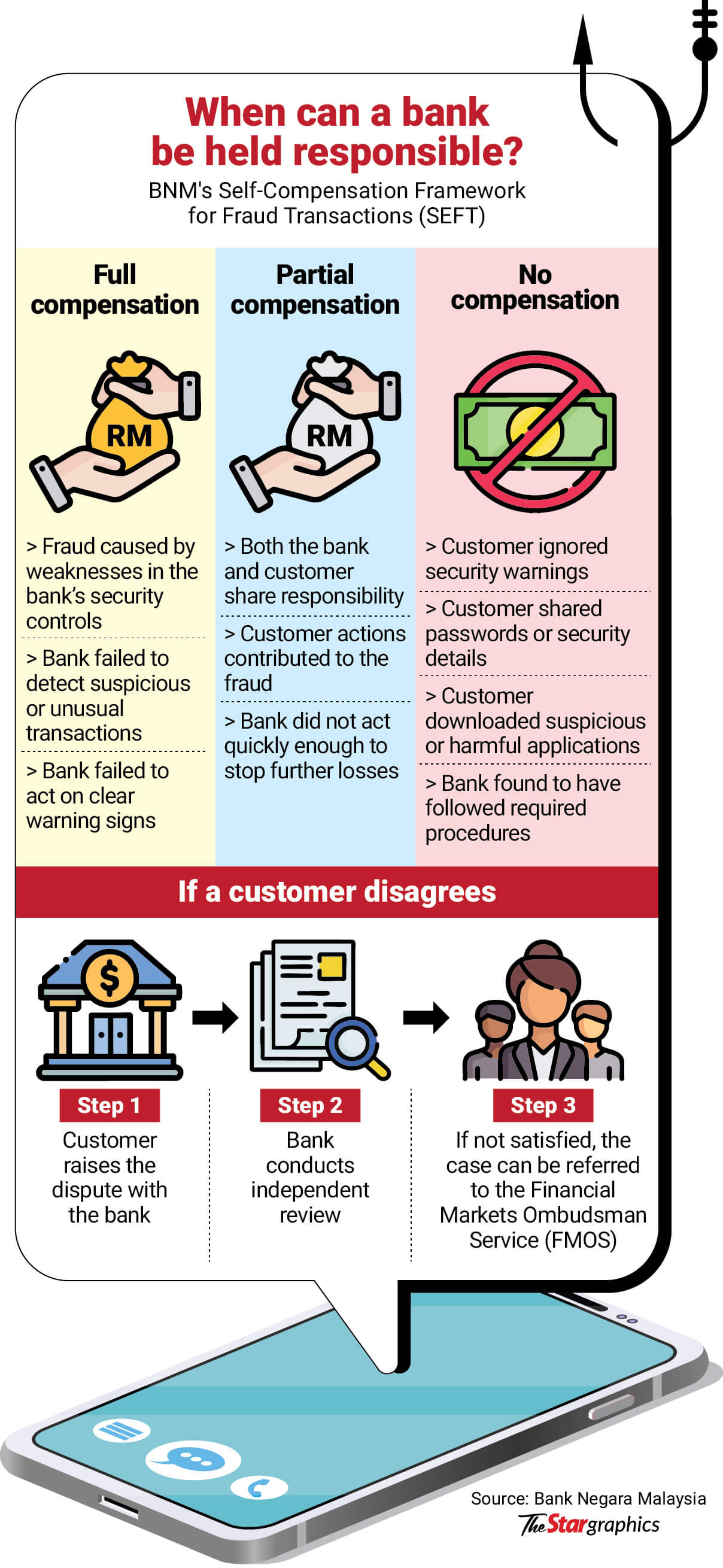
Enhance fraud detection, checking banking fraud


CLICK TO ENLARGE

CLICK TO ENLARGE


Calls for improvements in detecting suspicious banking transactions

The issue has come under renewed focus following a Sessions Court ruling ordering a bank to compensate a customer RM166,000 over suspicious online transactions that went undetected.

As scams evolve, banks are facing heightened urgency to identify unusual transaction patterns and act fast, particularly as fraudsters exploit human behaviour and then move in to breach banking systems.

At a Bank Negara workshop on consumer protection and fair conduct reforms, its officers said existing laws protect the confidentiality of customer information and personal data in the financial sector.

“Financial institutions are robust but there is always room for improvements,” the officers said yesterday.

They said enforcement actions had been taken in instances where breaches were identified, including requiring the institutions involved to implement corrective action plans.

The officers also said Bank Negara continued to monitor banks on consumer protection and compliance matters.

In its latest annual report, the central bank stressed the need to strengthen fraud detection systems and reinforce internal safeguards to combat sophisticated online scams.

The central bank said banks and non-bank financial institutions were required to adopt advanced fraud detection measures and strengthen internal safeguards to quickly intercept suspicious transactions.

It also stressed for a proactive approach to prevent fraudulent transactions from escalating.

The central bank said that in recent years, financial institutions had strengthened various security measures including tighter fraud detection rules and triggers, cooling-off periods for new device registrations and stronger authentication methods.

These measures contributed to a 52% decline in unauthorised fraudulent transactions involving malware and phishing reported in 2024, and prevented over Rm399mil in attempted fraudulent transactions, it said.

However, Bank Negara also acknowledged that fraud patterns were becoming increasingly complex and harder to distinguish from genuine customer activity.

Bank Negara said banks and consumers shared responsibility for safeguarding digital banking security, but reiterated that financial institutions had to determine whether weaknesses in their internal controls contributed to fraud incidents.

It also introduced the Selfcompensation Framework for Fraud Transactions (SEFT) under its Policy Document on Ensuring Fair Treatment for Victims of Unauthorised e-banking Transactions.

SEFT outlines how banks should assess fraud cases and determine compensation based on the responsibilities of both financial institutions and customers.

According to Bank Negara, more than 95% of online fraud cases in Malaysia involved authorised transactions – where victims were manipulated into willingly transferring money to scammers.

Federation of Malaysian Consumers Associations (Fomca) vice-president Datuk Indrani Thuraisingham agreed that banks should adopt more proactive intervention measures when transactions appear inconsistent with a customer’s normal behaviour.

“Banks are clearly not doing enough. Fraudsters now exploit human behaviour more than banking systems,” she said.

“Banks must transition from passive logging to active, pre-emptive intervention.”

https://www.thestar.com.my › nation › 2026/05/22 › sle...

Related post:

Banks must rethink fraud controls as AI risks rise


Friday, May 8, 2026

Draw the line on blood-taking

 Doctors urge cleaner rules on pharmacy services

Needling concern: Calls are growing for invasive clinical procedures to be carried out at licensed facilities and that consistent enforcement is carried out against premises offering blood-taking services without proper approval.

PETALING JAYA: There is a need to clearly define the scope of services pharmacies can and cannot provide, particularly the distinction between finger-prick screening, venous blood-taking, laboratory testing, diagnosis and treatment, says a doctors’ group.

The Private Medical Practitioners’ Association of Selangor and Kuala Lumpur has also called for consistent enforcement against premises offering blood-taking services without proper approval.

Its president, Dr Eugene Chooi, said clear guidelines should be issued to all healthcare providers to eliminate ambiguity and ensure consistent patient safety standards.

“Patient safety must be protected through enforcement that is timely, transparent and fair,” he said.

Dr Chooi was responding to a statement from the Health Ministry that operators of premises providing blood collection or phlebotomy services without a licence could be fined up to RM500,000, jailed for up to six years, or both.

“Community pharmacists play an important role in medication counselling, health education and basic screening within their professional scope.

“The issue is clear, blood-taking is an invasive clinical procedure.

Refined grace in every step

“It must be performed within properly registered healthcare facilities, under clear clinical governance and accountability,” he added.

He said such procedures carry real risks and must be carried out by trained and authorised personnel in regulated settings, stressing that there should be no shortcuts, grey areas or double standards.

Dr Chooi said Malaysia does not lack healthcare regulations but enforcement has been inconsistent.

He said the public was now confused after years of seeing blood test promotions in non-clinical settings, which may have created the impression that such services are permitted.

He warned that blood-taking involves infection-control risks, proper patient identification, specimen handling and clinical interpretation, adding that blurred boundaries between screening, diagnosis and treatment could lead patients to delay seeking care or misinterpret results.

“That puts public safety at risk.”