Share This

Showing posts with label energy efficiency. Show all posts

Tuesday, March 10, 2026

Real-life rating for airconds


'CLICK TO ENLARGE'

PETALING JAYA: Air conditioner units will now be rated by how well they perform in real life, but experts say the new ratings will take time to be accepted by consumers.

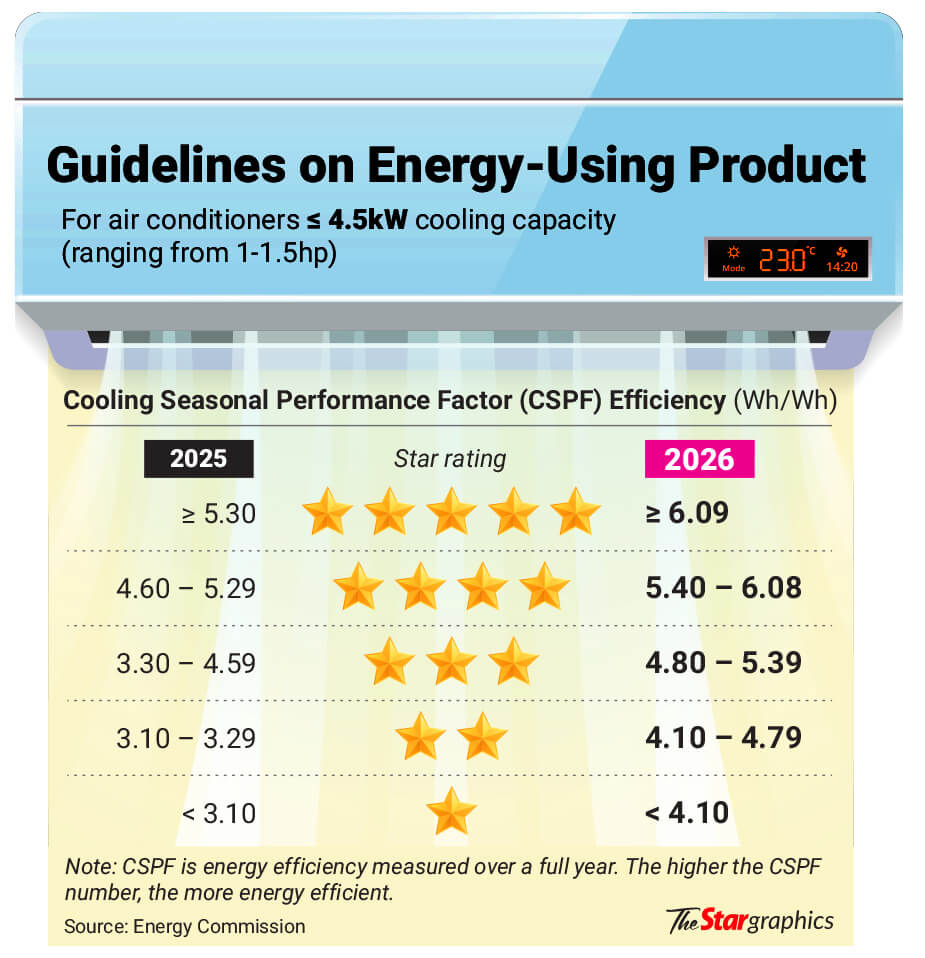
Under the framework updated in January, a unit will be judged by how efficiently it cools a room relative to the electricity it consumes over a year, with higher values indicating better energy efficiency, rather than fixed laboratory conditions.

The change means the star rating now reflects real-life cooling performance more accurately rather than just controlled test results.

The rating is aimed at helping households better identify more energy-efficient air conditioner units which are usually pricier.

Previously, air conditioners were rated largely based on fixed laboratory testing conditions, where five stars indicated the most energy-efficient units under the earlier benchmark.

While the system still uses the familiar one to five-star labels, the performance benchmarks have been tightened.

The changes aim to curb rating inflation, drive manufacturer innovation and support national energy-efficiency goals as air conditioner ownership continues to rise.

ALSO READConsumers now more aware of energy efficiency

Universiti Tenaga Nasional senior lecturer Dr Amar Hisham Jaafar, who led a national research project on the local electrical appliance market, said the revised labels under the new Guidelines on Energy-Using Pro­duct framework made it easier for consumers to distinguish genuinely efficient products.

“Air conditioners are already a common household appliance. The Statistics Department reported that 68.8% of households owned air conditioners in 2024.

“When air conditioners are used daily, mainly at night, electricity cost becomes a long-term household commitment rather than a one-off purchase decision,” he said.

Amar Hisham said the revised rating system will help households opt for models which could deliver the same level of comfort using less electricity.

“When a label is credible and the performance criteria tightened, it becomes easier for consumers to distinguish genuinely efficient products from those that only look attractive based on price,” he added.
'CLICK TO ENLARGE'
'CLICK TO ENLARGE'

He said households that relied heavily on air conditioning are likely to consider higher-efficiency models, even if it costs more initially, as energy savings will accumulate over time.

“The revised schedule raises the benchmark for new products entering the market. It does not mean that existing air conditioners suddenly become inefficient overnight.

“Air conditioners typically last between 10 and 15 years if properly maintained. Regular servicing, cleaning the filters and setting reasonable temperatures can help households keep the unit running efficiently,” he said.

On the revised rating system, Amar Hisham said labels alone might not be enough to change buying behaviour, mainly among lower-income households.

“Labels work best when they are combined with public understanding and practical support.

“Clearer explanations of how star ratings translate into electricity use and monthly costs will help consumers make better purchasing decisions,” he said.

Federation of Malaysian Consumers Associations (Fomca) chief executive officer Saravanan Thambirajah advised consumers to better understand lifetime ownership costs rather than focusing solely on sticker prices.

“For households that use air conditioners frequently, the difference in electricity consumption between low-efficiency units and four- to five-star models can be significant.

“Families can realistically expect savings of about 20% to 40% on cooling-related electricity use, depending on usage patterns.

“Over several years, that can translate into hundreds or even thousands of ringgit,” he said.

Related stories:

Wednesday, July 2, 2025

Powering down to keep the lights on


Sigh of relief: Habsah showing her electricity bill at her house in Gertak Sanggul. — LIM BENG TATT/The Star

Many using less electricity as new tariffs loom

PETALING JAYA: Many consumers are taking steps to manage their electricity bills with the implementation of the new tariff structure by the government.

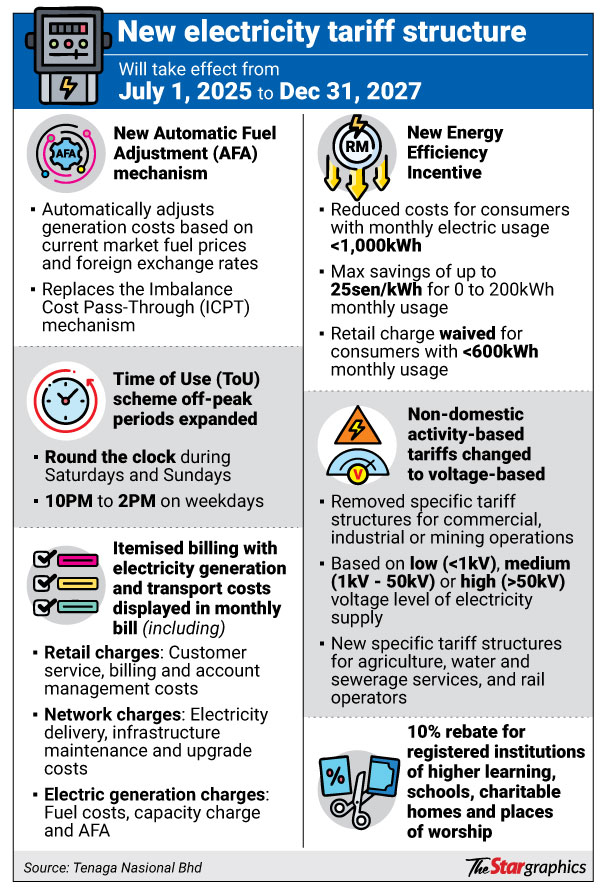
For example, many homeowners are considering having solar photo­voltaic (PV) systems installed on their roofs, while others are looking at the “Time of Use” scheme, which offers lower rates during off-peak hours, now defined as starting from 10pm to 2pm on weekdays, and the entire day on weekends.

Under the new tariff announced by the Energy Commission, domes­tic consumers using less than 1,000kWh (kilowatt-hours) per month will also continue to enjoy subsidies, effective yesterday.

ALSO READ: Brace for price hikes across the board, consumers told

In Johor Baru, sales operations executive Ereena Karen Lim Abdullah, 47, and her husband are thinking about rooftop PV.

“My husband and I are thinking of installing solar panels, but we are unsure whether it is possible to do so at our apartment,” she said, adding that she would raise the matter with the building management soon.

“I used to pay around RM100 for electricity monthly but it had crept up to RM150 even though it is just me and my husband living in our apartment without much changes to our routine.”

ALSO READ: ‘We may have no choice but to hike prices’

Events planning manager Evelyn Lee, 34, said she was hoping to apply for the newly expanded Time of Use (ToU) tariff as soon as possible since it matches her lifestyle.

“My husband and I are seldom at home during the day, so it’s perfect for us since we are typically home only by 10pm.

“We also like to spend our weekends at home together, just relaxing with our dogs with the air conditioning on, so it makes sense,” said Lee, who lives in Puchong.

CLICK TO ENLARGECLICK TO ENLARGE

In Seremban, Tong Sim Old Folks Home secretary Jessie Chan said they had already been cutting back usage before the new tariffs.

“The 18 elderly and special needs folks at the centre have been told to cut down (on their use), resulting in our monthly bill going down slightly from the over RM400 previously,” she said.

Ramesh Patel, who runs the Vivekananda Home in Rembau, has also told the children under his care to start conserving.

“We went from switching on four lights throughout the night previously, to only one now to further reduce the monthly bill which totals about RM800.”

Retiree N. Manimaran from Perak said he would start consolidating his chores.

“We now do the laundry only once every two days, while clothes are ironed once per week. I’m also cutting down the hours the air conditioner is on from six to four,” said the 67-year-old.

Father-of-four Wan Fahmi Ahmad said getting his household to change their habits would be difficult as they do not know how the new tariff structure would affect their bill.

“We are used to using around 1,500kWh to 2,000kWh, and paying over RM1,000 every month, so convincing them will be hard, especially if our bill increases only by a small amount,” the 51-year old pilot said.

Wan Fahmi, who lives in Putrajaya, added that he would consider the ToU scheme if his bill spiked significantly.

Likewise, Halimatul Abdul Adib, 42, is also adopting a wait-and-see stance.

“I don’t think I will see any significant rise in my bill, though I will wait for a few billing cycles so I can make a better comparison before doing anything.”

In George Town, pensioner Habsah Sulaiman, 70, said the new tariff helped her family.

“I usually use under 300kWh a month or an average of RM150, so it is good that the government is keeping the subsidy,” said Habsah, who lives with her son and his family, including three children.

Technician Kevin Wang, 26, said while the new tariff would support efforts to reduce carbon emissions, affordability remains a key concern.

“I am all for a greener future. But any transition must be gradual, especially for middle-income families like mine.

“The government or utility providers can introduce targeted rebates or energy-efficiency incen­­tives to ease the impact.”

The Light Hotel general manager Raj Kumar said it was too early to predict whether the new tariff would impact room rates.

“We are also actively exploring cost-saving measures such as solar PV,” he said, while stressing the importance of finding a balanced solution that protects both consumers and businesses.

“It is a tough time for everyone, and we do not believe in simply passing every cost to the customer,” Raj said.

Source link

Related stories: