Share This

Showing posts with label National security. Show all posts

Saturday, August 1, 2026


Governance Bill will not apply to personal use

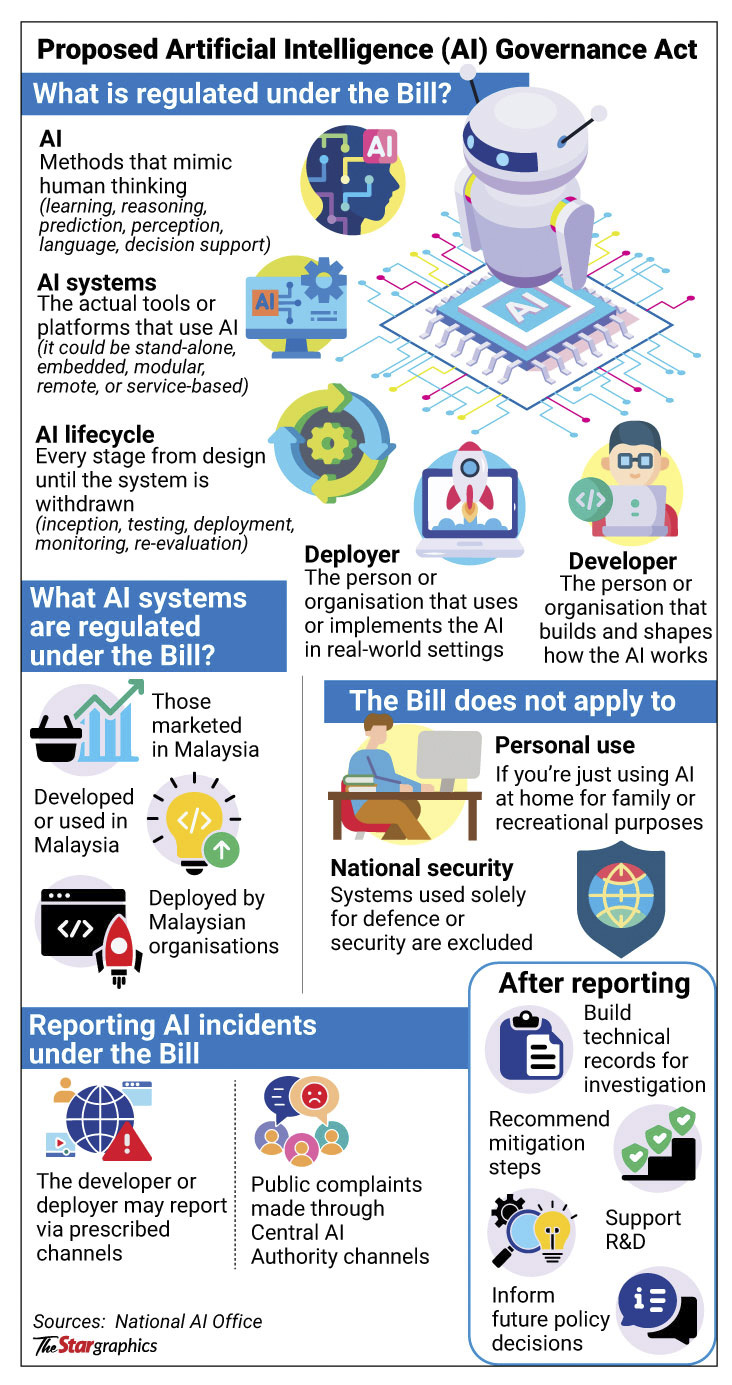
PETALING JAYA: Artificial intelligence (AI) systems, the AI lifecycle, as well as AI developers and deployers, are set to be regulated under the proposed Artificial Intelligence Governance Bill.

However, the Bill will not apply to the personal use of AI or on matters of national security.

Intended to serve as a national legal framework for the safe, responsible and innovation-enabling use of AI, the law will apply to systems placed on the Malaysian market or put into service in Malaysia.

ALSO READ: Evolving AI could outpace regulation, warn experts

It will also apply to AI systems designed, developed or used here, as well as those used by deployers set up in Malaysia, regardless of where the systems are physically hosted.

The proposed AI Governance Act is guided by five key principles: protecting human dignity and rights, transparency and explainability, accountability, safety and security, and responsible data governance.

Together, these principles provide the foundation for the responsible development, deployment and use of AI systems, while promoting trustworthy AI, innovation and public confidence.
CLICK TO ENLARGE
CLICK TO ENLARGE

According to the public consultation document released by the National AI Office (NAIO), the Bill will adopt a principle-based approach by setting out national AI Governance Principles to guide the responsible development, deployment and use of AI, with implementation supported through standards, guidelines and other instruments.

It also adopts a risk-based approach, with regulatory obligations proportionate to an AI system's level of risk, categorised into three levels: unacceptable, high and low.

This means that higher-risk systems will face stricter governance requirements while lower-risk applications will be subject to lighter obligations.

The risk framework is anchored on “harm”, which includes death, bodily injury, unlawful deprivation of fundamental liberty anchored to the Federal Constitution, and the contravention of any written law.

The Bill also categorise AI incidents to include failures, weaknesses, misuse, unexpected effects and near misses.

It will also require incidents to be reported, including the nature of the incident, its foreseeable harm, the containment measures taken, the root cause (where applicable), and the remediation actions implemented.

The Bill also proposes a central AI authority as the principal national body for AI governance, whose role will be to oversee and operate the national “baseline” principles and standards to strengthen the overall AI ecosystem by addressing gaps in capacity across sectors.

The authority will oversee AI safety by maintaining a risk framework, supervising assessments, supporting testing, developing incident reporting mechanisms and engaging in international technical cooperation.

It will also be responsible for investigations and enforcement, including technical fact-finding when AI incidents occur, determining what happened, identifying the systems and actors involved, as well as producing findings to support corrective actions.

In addition, it will carry out capacity-building functions for the public sector by developing guidance, templates, training and practical support for public authorities, regulators, AI sandbox operators or overseers, and regulated organisations to help them comply with the framework.

The authority may also appoint "Sectoral Leads", who will be delegated specific powers under the Bill to support the implementation of the framework, where they have the legal authority, technical expertise and governance capacity.

The proposed amendments in the document are not final and remain subject to further review and amendment.

Digital Minister Gobind Singh Deo said in June that the government will adopt a two-pronged approach by using existing laws to prosecute those who misuse content, while also drafting the AI Governance Bill to further strengthen prevention and accountability throughout the technology’s lifecycle.

He said the move is aimed at ensuring that risks posed by high-capability technologies such as deepfakes, synthetic content and identity manipulation can be addressed at an early stage.

Ultimately, according to the public consultation document, the Bill aims to set up a central oversight framework that works alongside existing sectoral regulators to enable coordinated governance while addressing industry-specific risks and operational needs.

“This will allow public bodies, including existing regulators, to collaborate within a common governance framework, while retaining the flexibility to address sector-specific risks and operational needs,” it said.

The NAIO will be launched tomorrow.

Related stories:
20 Jul 2026The speech focused on China's governance philosophy of prioritising AI risk prevention and control while advancing secure, controllable, and ...Read more

Saturday, June 17, 2023

Decline and fall of empires


In the last decade, the US security elites seized power from Wall Street for greedily selling out American hegemonic interests. — Bloomberg


You can say that there is no clash of civilisations, but rather a clash of national praetorian guards who feel that their interests are being threatened, sometimes not just by foreign intrusion but also weak leaders who betray their interests.


EVERY empire has its grand historian to explain more its successes than failures. In 1776, when Adam Smith published his classic “Wealth of Nations”, British essayist Edward Gibbon (1737 to 1794) wrote an equally famous text, “History of the Decline and Fall of the Roman Empire”.

The year 1776 was a historical turning point, when Britain lost her American colonies, even as she focused on conquering India 19 years after the 1757 victorious Battle of Plassey against the Mogul empire and their French allies.

Gibbon attributed the Roman fall to “four principle causes of the ruin of Rome, which continued to operate in a period of more than a thousand years. (I) The injuries of time and nature. (II) The hostile attacks of the Barbarians and the Christians. (III) The use and abuse of the materials. And (IV) The domestic quarrels of the Romans.”

His warnings apply even today, even though he was reminding the rising British elites what to look out for in the bid for Empire.

Interestingly, Chinese historians attribute dynastic decline and fall to “external invasion and internal troubles” .

Rome was built on conquest. Her Roman legions were legendary, but the elite core that defended consuls, procurators and emperors were the Praetorian Guard, who exercised the intelligence, logistics and national security functions of the Roman empire.

The Roman empire rose as the effectiveness of Roman military discipline and organisation overwhelmed all enemies.

The Praetorian Guard was the core staff between the consul, like Julius Caesar, and his legions.

They also supervised the intelligence functions, initially undertaken by the Frumentarii, involved in strategy, logistics, information couriers and negotiations with allies and enemies alike.

Within Rome, as the elite defending the capital, the Guardians later became king-makers, since weak emperors needed the military on their side.

They helped in assassination of at least one emperor and putting several others on the throne.

Fast forward to the First World War.

Amidst Europe’ ruinous self-destruction, German polymath Oscar Spengler (1880 to 1936) wrote The Decline of the West, positing that empires or civilisations have the same human biological cycle of birth, life and death.

He famously speculated that the West would enter into a crisis after two centuries of Caesarinspired concentration of power into one leader would lead to collapse of Western civilisation.

Indeed, he warned that the spread of Western technology to the “coloured races” would be used against the West. Sounds familiar? Spengler was discredited after the Second World War for being an inspiration behind Nazi expansion.

Thereafter, British historian Arnold Toynbee (1889 to 1975) 12-volume Studies in History gave Spengler fatalism an optimistic twist.

His study of 26 civilisations showed that empires can rise to historical challenges when their elites respond creatively with innovation and technology.

In other words, those elites, including emperors, presidents or political leaders who are guardians of empire integrity, can succeed to grow empires.

But when that elite becomes predatory through corruption and infighting, the empire or civilisation weakens and falls to a combination of internal collapse and foreign invasion.

Every nation has their own praetorian guard or cohort of agencies in defence, national security, intelligence and think tanks that safeguard the national interest.

A modern parallel would be the Washington blob (national security elite) that comprises the Pentagon, State Department, intelligence community and foreign affairs think tanks.

Former US President Eisenhower called it the “military industrial complex”.

Moscow’s praetorian guard is labelled the Kremlin.

Countries like China, Russia, India, France and Japan have their own praetorian elite, who consider their mission to safeguard national integrity against all enemies, including threats to their national identity, creed and values.

You can say that there is no clash of civilisations, but rather a clash of national praetorian guards who feel that their interests are being threatened, sometimes not just by foreign intrusion but also weak leaders who betray their interests.

In the last decade, the US security elites seized power from Wall Street for greedily selling out American hegemonic interests.

As chairman Mao said, “political power comes from the barrel of a gun”, meaning that those who have the military behind them beat those who don’t.

Hence, stable governments are those that are able to keep the military in their barracks.

Those who do not keep the military happy are vulnerable to coup d’etat.

But what if the praetorian guards’ interests are not aligned with those of the masses, who only want peace and stability, including better jobs, health and less government intervention?

In this age of confusion and distorted media, the masses are rightly worried whether their praetorian guards are looking after their interests or after their own?

This is reflected in recent serious loss of public trust in elites, which feeds the populist desire to have one of their own to oversee the elites.

Donald Trump has pitched himself in that populist category.

The more the blob tries to prevent him from returning as Presidential candidate, including his recent indictment, the more Trump’s supporters will hunker down in their belief that the praetorian elites are looking after their own skin.

Ancient history therefore tells us that empires decline if their elites are feeding at the trough at the expense of the masses.

They sometimes start wars to deflect anger against them towards anger against barbarians.

Are there parallels in the current age? 

Related


 Bullying Empire: How US tries to rule world's internet through sanctions, China slander campaigns

In the fifth installment of this series, the Global Times looks into how this "bullying empire" tries to stamp the world's internet with US rules and values, and its attempts to curb China's rise in the digital sphere, through various ...


Related posts:

Can the great powers avoid war?


Moral vacuum at the heart of modernity, now embodied in US laws!


The crown and the colony


The Queen Mother's coffin, the wreath of white flowers and the Queen Mother's coronation crown with the priceless Koh-I-Noor diamond on April 8, 2002.


‘Empire of hackers’ uncovered


 As agreed upon by both China and the US, US Secretary of State Antony Blinken will visit China from June 18 to 19, the Chinese Foreign Min..
 
  High-level talks between China and the United States in Tianjin. 史无前例! 中美天津會談 史無前例! 第一次有一個國家……… Unprecedented! China-U.S. Tianjin