Share This

Tuesday, July 15, 2025

China, Australia strengthen green energy, tourism cooperation during Albanese’s official visit


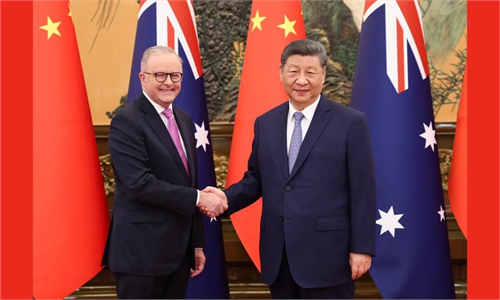
China Australia photo: VCG

Australian mining and metals multinational BHP Group on Monday announced cooperation with Chinese leading battery manufacturers Contemporary Amperex Technology Co Ltd (CATL) and BYD to accelerate its electrification of mining operations, as China and Australia eye strengthened cooperation during Australian Prime Minister Anthony Albanese's ongoing visit to China.

Melbourne-based BHP said it has signed memoranda of understanding (MoUs) with CATL and FinDreams Battery Co, a fully owned subsidiary of BYD Group, to collaborate on battery development for mining equipment and locomotives including rapid charging infrastructure, as well as energy storage and battery recycling, according to two separate press releases on its website.

The moves come as Albanese is on an official visit to China. According to the Australian Financial Review, top executives from BHP, Rio Tinto, Fortescue and Hancock Prospecting are among scores of business delegates travelling with Albanese.

Speaking before a meeting between Australian iron ore miners and Chinese steelmakers in Shanghai on Monday, Albanese framed green steel as a way to grow Australia and China's decades-long trade relationship, Reuters reported.
"Achieving the goal of the Paris Agreement would require the decarbonization of steel value chains, presenting an opportunity for Australia and China to progress our long-term economic interests," he was quoted as saying.

"Rio Tinto is working closely with our Chinese customers to support the development of low-carbon steelmaking technologies, leveraging Australia's high-quality iron ore and China's manufacturing expertise to drive real progress on emissions reduction," Kellie Parker, Rio Tinto Australia chief executive, told the Global Times on Monday. 

"This visit is a valuable opportunity to deepen collaboration between suppliers and steelmakers. We welcome the opportunity to participate in these discussions alongside the Prime Minister," Parker said.

China has been taking concrete steps toward its commitment to peak carbon emissions before 2030 and achieve carbon neutrality before 2060. Over the years, the country has made remarkable progress in clean energy development, emerging as a global leader driving both domestic decarbonization and international sustainable development.

China and Australia have sound cooperation in traditional energy fields such as natural gas and coal, and green energy is an emerging field that has enormous room for cooperation, Ning Tuanhui, an associate research fellow at the China Institute of International Studies, told the Global Times on Monday.

"Australia has abundant deposits of minerals including lithium, cobalt and rare earths, while China has technological advantages and rapid development in the new-energy industry. Given their complementarity, strengthened green energy cooperation is beneficial to both sides," Ning said, noting that China is a critical partner for Australia to boost energy transition and address climate challenges.

In addition to energy, Albanese also reportedly highlighted tourism and sporting ties with China during his visit - his second official visit to China but the first since his re-election in May. On Sunday in Shanghai, Albanese visited the headquarters of Chinese online travel platform Trip.com and witnessed the signing of an agreement between Tourism Australia and Trip.com, according to information the platform sent to the Global Times on Monday.

Video footage posted by ABC News also showed that on Sunday, Albanese took part in a morning workout at the iconic Shanghai Bund, accompanied by Shanghai Port FC's Australian coach Kevin Muscat, team captain Wang Shenchao and others. He was presented with a special commemorative jersey.

Amid increasingly stabilizing and improving ties between China and Australia over the past three years under the strategic guidance of the leaders of the two countries, Albanese's visit to China marks a pivotal step in further advancing bilateral economic and trade relations, Song Wei, a professor at the School of International Relations and Diplomacy at Beijing Foreign Studies University, told the Global Times on Monday.

China has been Australia's largest trading partner, export destination and source of imports for 16 consecutive years. The China-Australia Free Trade Agreement, which came into effect in 2015, has significantly boosted trade, with total trade surpassing $210 billion in 2024, according to an article by Chinese Ambassador to Australia Xiao Qian published by the People's Daily on Sunday. 

Strengthening dialogue, expanding the scope of economic cooperation and increasing people-to-people exchanges will bring more tangible benefits to bilateral cooperation, Song said.

"Given the complex and volatile geopolitical landscape, frequent high-level exchanges like this visit are needed to build mutual trust and strengthen the resilience of bilateral relations," Ning said.


Repated posts:


RELATED ARTICLES

Saturday, July 12, 2025

BE LABEL-SAVVY TO STAY HEALTHY for organic food among health-conscious consumers


PETALING JAYA: The multi-billion-­ringgit global organic food and beverage market is expected to grow more by 2030, according to market research firm Grand View Research.

For Malaysia, there is a growing appetite for organic food among health-conscious consumers.

CLICK TO ENLARGECLICK TO ENLARGE

But how do people know whether the “organic” foodstuff they buy are truly organic?

An important source is the myOrganic sticker that is usually found on the packaging of organic foodstuff sold at shops.

The myOrganic certification scheme is used to promote, implement and facilitate the adoption of organic agriculture, explains Agriculture Department (DOA) director-general Datuk Nor Sam Alwi.

“This certification scheme covers various organic activities, including fresh produce farming, beekeeping, the breeding of organic plant varieties and wild harvesting.

ALSO READ: Verifying food markers not quite an organic process

“The Malaysian Organic Certification Scheme is now known as myOrganic,” she said in in a statement to The Star.

To safeguard the authenticity of certified organic products, the regulation of organic items is primarily governed under the Food Act 1983 and Food Regulations 1985, overseen by the Health Ministry, she added.

The Agriculture and Food Security Ministry has also registered the myOrganic certification logo with the Intellectual Property Corporation of Malaysia (MyIPO) as a legitimate trademark.

“If the DOA receives complaints about the misuse of this logo, the matter will be referred to the Domestic Trade and Cost of Living Ministry for further investigation.

“In cases where fraud is confirmed, the offending company may be prosecuted under the Trademarks Act 2019,” she said.

Upon conviction, offenders may face a fine of up to RM10,000 per item bearing the misused trademark, imprisonment of up to three years or both.

ALSO READ: How bugs help you spot organic durians

Nor Sam said the department has issued guidelines to certificate holders outlining the terms and conditions for the use of the myOrganic logo.

“However, we also rely on the cooperation of consumers to address the risks of fraud and logo misuse by lodging complaints where appropriate.

“Matters related to processing, repackaging or importation of organic products fall strictly under the jurisdiction of the Health Ministry,” she said.

To create awareness, the department is actively carrying out promotional activities targeting consumers through physical events and social media platforms, as well as by engaging with local organic associations.

“These initiatives focus on promoting Good Agricultural Prac­tices (GAP), highlighting the importance of recognising the myOrganic logo, encouraging the purchase of certified farm produce.

“Additionally, consumers can verify the validity of organic certification by visiting the DOA website at www.doa.gov.my under the list of certified recipients,” she said.

Dr Juju Nakasha Jaafar, senior lecturer at the Faculty of Agri­culture at Universiti Putra Malay­sia, said there has been confusion on the authenticity of organic products.

“For example, a seller might claim he is selling pesticide-free or chemical-free vegetables, which gives consumers the impression that the products are organic.

“In reality, these vegetables may be free from chemical pesticides but are still grown using chemical fertilisers and thus do not qualify as organic,” she said.

“For vegetables to be certified as organic, all input must be completely natural.

“This includes compost fertilisers, organic pesticides and non-genetically modified organism seeds.”

These are outlined in the myOrganic certification guidelines.

“Consumers can look for the myOrganic logo on vegetable products to ensure they are truly organic.

“The DOA strictly regulates this certification,” she said, adding that more details can be found on the DOA website.

Federation of Malaysian Consumers Associations (Fomca) secretary-general Dr Saravanan Thambirajah said traders must verify the certification documents provided by suppliers before selling or labelling any product as organic.

“They should only use the term ‘organic’ when backed by certification,” he said.

Saravanan said consumers should look for official certification logos on packaging and not rely solely on general claims like ‘natural’.

“If you suspect a product is being falsely marketed as organic, you should report it to the Domestic Trade and Cost of Living Ministry or lodge a complaint with Fomca,” he added.--

By KHOO GEK SANDIVYA THERESA RAVIRAGANANTHINI VETHASALAM

https://www.thestar.com.my/news/nation/2025/07/12/be-label-savvy-to-stay-healthy

Friday, July 11, 2025

China, ASEAN vow co-op amid global challenges

Partnership a crucial pillar for regional, world devt, stability: expert


Chinese Foreign Minister Wang Yi joins hands with ASEAN foreign ministers for a group photo during the ASEAN Post-Ministerial Conference with China at the Kuala Lumpur Convention Centre in Kuala Lumpur, Malaysia on July 10, 2025. Photo: VCG

China and ASEAN foreign ministers reaffirmed their wish for further cooperation and joint efforts to maintain regional peace and stability on Thursday during the China-ASEAN Foreign Ministers' Meeting held in Kuala Lumpur, Malaysia. Analysts believe that China-ASEAN cooperation has now become a crucial pillar for regional as well as global development and stability, especially amid the US' sweeping and coercive series of tariffs. 

China has always been the most reliable stabilizing force in a turbulent world and the most dependable partner for ASEAN members to address challenges, Chinese Foreign Minister Wang Yi said on Thursday at the meeting in the Malaysian capital. 

Noting that China and ASEAN share similar development concepts, common demands and integrated interests, Wang said that China regards ASEAN as a priority direction for neighborhood diplomacy and a pioneer area for promoting the building of a community with a shared future for mankind.

Wang also a member of the Political Bureau of the CPC Central Committee, briefed the achievements of China-ASEAN cooperation and put forward four proposals.

Wang said that China is willing to work with ASEAN countries to practice open regionalism and true multilateralism and make greater contributions to regional and global governance.

In terms of win-win cooperation, Wang said that China is willing to work with ASEAN to build China-ASEAN Free Trade Area 3.0, implement the Regional Comprehensive Economic Partnership Agreement to a high quality, and create a high-level free trade network.

While stating that China is willing to take the lead in signing the Protocol to the Treaty on the Southeast Asia Nuclear Weapon-Free Zone, Wang stressed that the South China Sea is the common home of regional countries, rather than a "gladiatorial arena" for major powers. 

China is willing to expand cooperation with ASEAN members in areas such as marine environmental protection, navigation safety, maritime law enforcement and key marine infrastructure, fully implement the Declaration on the Conduct of Parties in the South China Sea, and advance consultations on the Code of Conduct (COC) in the South China Sea, Wang said. 

China is willing to continue to advocate dialogue, exchanges and mutual learning among different civilizations with ASEAN countries, Wang said.

The participating countries said that China has always been one of the most important dialogue partners of ASEAN, and they are willing to accelerate the alignment of development strategies with China, and cooperate under the Belt and Road Initiative at a high quality, according to the release from the Chinese Foreign Ministry. 

They also said that they are willing to work with China to safeguard multilateralism and the multilateral trading system and jointly address global challenges, further strengthen unity and cooperation with China, jointly advance the modernization process in Asia, and promote regional peace, stability and prosperity.

"The China-ASEAN relationship is now a vital pillar for regional as well as global development and stability," Luo Yongkun, a researcher at the Institute of International Studies of the Shanghai Academy of Social Sciences, told the Global Times on Thursday. 

Against the backdrop of tense major power relations and the impact of the US tariff war on regional development, the numerous consensuses reached between China and ASEAN on cooperative development and maintaining regional peace and stability align with the aspirations of all parties, marking a significant outcome of this foreign ministers' meeting, Luo noted. 

According to the Chinese Foreign Ministry, participants said they appreciate China's willingness to take the lead in signing the Protocol to the Treaty on the Southeast Asia Nuclear Weapon-Free Zone, and look forward to the early conclusion of the COC in the South China Sea by all parties. 

Ge Hongliang, Vice Dean of the ASEAN College at Guangxi Minzu University, told the Global Times that China and ASEAN have a shared vision for implementing denuclearization and the peaceful use of nuclear resources in Southeast Asia.

According to the expert, China's willingness to take the lead in signing [Protocol to the Treaty on SEAWFZ] demonstrates Beijing's support for ASEAN-led regional governance frameworks, which is of great significance to maintaining regional security order, particularly nuclear safety.

In addition, the positive stance of ASEAN countries on the South China Sea issue is conductive to establishing a platform for dialogue and communication between China and Southeast Asian nations on South China Sea matters, enhancing mutual trust, Ge added. 

US Secretary of State Marco Rubio met counterparts in Southeast Asia on Thursday during his first visit to the region since taking office, according to Reuters. 

It comes as the US government rolls out higher tariffs against Southeast Asian nations. Washington has announced plans for tariffs on Malaysia and five other ASEAN countries, with Malaysia facing a 25 percent tariff, Laos and Myanmar 40 percent, Cambodia and Thailand 36 per cent, and Indonesia 32 percent, starting from August 1, the Straits Times reported. 

Addressing the opening of the China-ASEAN Foreign Ministers' Meeting, Malaysia's Foreign Minister Datuk Seri Mohamad Hasan hailed the enhanced China-ASEAN economic cooperation, saying that the signing of the ACFTA 3.0, which is scheduled for later this year, comes at an opportune moment, according to Malaysian national news agency Bernama.

China and ASEAN remain dedicated to deepening ties and advancing regional cooperation, actively promoting the development of industrial chains that enhance regional stability, and bolstering the resilience of regional trade and investment, so as to counter the trade coercion and unilateralism from Washington, said the expert. 

In 2024, China and ASEAN had already been each other's largest trading partner for the fifth consecutive year, the Xinhua News Agency reported. Official data shows that the zero-tariff coverage rate between China and ASEAN has remained at above 65 percent. In 2024, bilateral trade in goods reached $982.34 billion, a year-on-year growth of 7.8 percent.

"Southeast Asian countries have many grievances against the US, perceiving its tariffs as a means of geopolitical coercion," Luo said, "While China's consistent and robust economic growth provides regional countries with confidence and stability."- Global Times

Govt urged to intervene as new US tariff brings jitters for businesses


Trying times: The tariff would significantly impact manufactures like those in Bayan Lepas, Penang. — CHAN BOON KAI/The Star

JOHOR BARU: The 25% tariff imposed by the United States on Malaysia has sent jitters through the manufacturing sector, with many warning of cancelled orders and a potential wave of business closures.

The furniture industry, for one, fears losing business to Vietnam, which faces a 20% tariff, while some other industries are even thinking of relocating.

Malaysian Furniture Council president Desmond Tan said Vietnam, Malaysia’s closest competitor in the global furniture market, produced a similar range of products and targets the same export destinations – especially the United States.

The tariff for Vietnam was reduced to 20% from the original 46%.

“Since the announcement was only made yesterday (Tuesday), it is still too early to gauge the full extent of its impact on order volumes but the council will continue to monitor developments closely,” he said.

Tan said the industry was also being squeezed by rising costs on the domestic front.

“These include the expanded Sales and Service Tax (SST), which now imposes a 5% tax on raw materials and directly drives up production costs. We also face higher labour expenses with the new minimum wage,” he added.

The new Employees Provident Fund contributions for foreign workers would add further strain while fuel and electricity prices had also gone up, he said.

The council is now urging Putrajaya to commence urgent talks with the United States to negotiate a reduction of the tariff.

He also appealed for a rethink on the new taxes and price hikes to lower production costs, and for export incentives to protect jobs.

The United States accounts for 60% of the country’s total furniture exports, totalling RM2.039bil in just the first four months of the year.

Malaysia also exports furniture to Singapore, Australia, Japan and the United Kingdom, among others.

Muar Furniture Association president Steve Ong said the new tariff was a major blow, as Muar supplied more than RM4bil worth of furniture to the United States in 2024.

It made up 67% of Malaysia’s total furniture exports there, he said.

“The 25% tariff will likely lead to clients cancelling orders and local manufacturers scrambling to stay afloat. This is an urgent crisis,” Ong said.

Another industry player urged the government to act swiftly.

“If nothing is done, a globally competitive industry like ours could shrink or even collapse,” said Goh Song Huang.

“At a time like this, we need clear, steady policies and a government that understands and responds to the real pressures we face.”

In Penang, local industries are bracing for reduced demand with some considering relocation.

“Companies in Malaysia may be forced to shift parts of their production to countries with lower tariffs,” said Malaysia Semiconductor Industry Association (MSIA) president Datuk Seri Wong Siew Hai, adding that higher prices driven by import tariffs tend to suppress global demand.

“When the cost of imported goods rises, demand naturally falls. In the end, everyone along the supply chain, especially buyers of raw materials, will be affected,” he said.

Earlier, it was reported that semiconductor exports would be exempt from the tariffs but it is unclear whether exemptions will remain under the new tariff regime.

“Vietnam’s tariff is at 20%, which gives them a pricing advantage. US buyers may look for cheaper alternatives, putting Malaysian exporters at a disadvantage,” he said.

Federation of Malaysian Manufacturing (FMM) Penang chapter chairman Datuk Seri Lee Teong Li said the 25% tariff would significantly impact exporters to the US.

“It’s a substantial amount. For local manufacturers shipping to the US, it will reduce profit margins. Costs will rise, and customers may start sourcing from other suppliers.

“Even when the 24% tariff was announced in April, it was already a heavy blow. We had hoped for a reduction, not an increase,” he said.

He noted that for now, the strategy was to ship out as much as possible before the Aug 1 deadline.

Meanwhile, the Associated Chinese Chambers of Commerce and Industry of Malaysia (ACCCIM) is urging the government to temporarily lower the expanded SST to 4% to ease the financial burden on businesses and preserve Malaysia’s competitive edge.

Its president Datuk Ng Yih Pyng said the government should reduce the expanded SST rate from the current 6%-8% for the first two years of implementation.

He said businesses, already grappling with higher operational costs driven by multiple government-imposed measures, would now have to face the the tariff headwinds and global uncertainties as well.

Source link https://www.thestar.com.my/news/nation/2025/07/10/govt-urged-to-intervene-as-new-us-tariff-brings-jitters-for-businesses

Wednesday, July 9, 2025

Sleep tips for people requiring care

 
If the dependent person you are caring for is not sleeping well, try out these ideas to help them.

MANY people dependent on permanent care have trouble sleeping, be it due to pain, sleep apnoea (frequent interruption of breathing during sleep), a repeated urge to urinate or something else.

As a result, they’re often dead tired the next day.

Among other things, this can increase their risk of falling, warns the Berlin-based Centre for Quality in Care (ZQP), a German non-profit foundation dedicated to improving longterm care of older care recipients.

If a care recipient suffers from chronic sleep deprivation, a doctor should be consulted.

Eliminating or alleviating the cause can help them to fall asleep more easily and sleep through the night.

There are also things that caregiving relatives can do.

Here are three:

1. Establish bedtime routines

A bedtime routine signals to the body that the day is over and it’s time to wind down and rest.

There are many different possibilities.

For some people it helps to read a few pages of a book.

Others prefer listening to relaxing music.

Since having cold feet is hardly conducive to sleeping well, taking a warm footbath before going to bed could be beneficial.

Or you could put on a pair of thick, warm socks before going to bed.

Part of the routine could be drinking a cup of calming tea, such as lemon balm, lavender, passionflower or hop, suggests the ZQP.

Better it be a smallish cup though, as drinking a large mug can result in an inconvenient need to urinate in the middle of the night.

2. Create a pleasant sleep environment

A noisy nearby street or bright TV standby light can interfere with sleep.

So care recipients and their caregivers should consider ways to improve the sleep environment.

Even minor adjustments can make a big difference, e.g. wearing earplugs to block out noise or a sleep mask to block out light.

It’s also important to ventilate the room in the evening to remove stale air.

A pleasant sleep environment also includes things that caregiving relatives might not think of right away.

If the care recipient suffers from urinary incontinence, for instance, a super-absorbent bed protector pad can provide more comfort.

3. Promote a normal day-night rhythm

The circadian rhythm, or “internal clock”, of dementia patients can become disrupted, causing them to feel sleepy during the day and restless at night.

This increases the risk of sleep problems, of course.

What’s more, it’s not uncommon that they want to eat at night.

The ZQP advises that caregivers meet these special needs as much as possible, but emphasises the importance of promoting a normal sleep-wake cycle by increasing morning light exposure and decreasing evening light exposure.

Light morning exercises in bed can help patients become alert, and their pyjamas shouldn’t be laid out until evening.

Complete darkness can unsettle dementia patients, however, the ZQP points out, so the room they sleep in shouldn’t be fully darkened.

A nightlight can help, as well as provide orientation in the dark. – dpa