Share This

Showing posts with label drugs. Show all posts

Monday, January 19, 2026

Under­stand­ing pop­u­lar weight-loss drugs


MALAYSIA is the most obese and over­weight nation in Asean.

Over­weight adults form 32.6% of the pop­u­la­tion, while obese adults form another 21.8%, adding up to 54.4% of the pop­u­la­tion.

Not only that, about 29.8% of chil­dren are obese or over­weight.

In addi­tion, about 21% of Malay­si­ans are dia­betic, of which 80% are obese or over­weight.

The Health Min­istry (MOH) is intro­du­cing glu­ca­gon-like pep­tide 1 (GLP-1) medi­cines for “vul­ner­able groups” this year.

Who the vul­ner­able groups are is unclear.

However, it behoves every­one to ensure that patient safety is not com­prom­ised by the use of GLP-1 medi­cines.

How they work

GLP-1 medi­cines are receptor agon­ists that mimic the GLP-1 hor­mone that is nat­ur­ally released in the gastrointest­inal tract in response to eat­ing.

When a per­son eats, the digest­ive sys­tem breaks down car­bo­hydrates into simple sug­ars that enter the blood­stream.

GLP-1 stim­u­lates the release of insulin from the pan­creas.

Insulin, a pan­cre­atic hor­mone, helps get gluc­ose out of the blood­stream into the body’s cells, where it is used for nour­ish­ment and energy.

In dia­betes, the body’s cells are res­ist­ant to insulin, do not pro­duce suf­fi­cient insulin, or both. GLP-I medi­cines stim­u­late the pan­creas to release insulin and reduce the release of glu­ca­gon.

Both insulin and glu­ca­gon con­trol the blood gluc­ose levels in humans, includ­ing type II dia­bet­ics.

GLP-1 medi­cines also act on the brain to reduce hun­ger and delay empty­ing of the stom­ach.

These drugs are used in the man­age­ment of type II dia­betes, and in some instances, obesity in non-dia­bet­ics.

They reduce food crav­ings, increase full­ness (sati­ety), slow diges­tion and can help con­trol blood gluc­ose.

GLP-1 medi­cines were licensed for dia­betes man­age­ment in Malay­sia in 2007, and was approved for obesity man­age­ment in 2019.

As of 2025, there are more than 30 GLP-1 medi­cines registered.

There are dif­fer­ent types of GLP-1 medi­cines.

Some are injec­tions and oth­ers

are tab­lets. Some are licensed for dia­betes, and oth­ers are licensed for weight-loss man­age­ment, or to treat the over­weight with weight-related health prob­lems.

Side effects

Like all medi­cines, GLP-1 agon­ists have side effects.

The com­mon ones are gastrointest­inal, i.e. nausea, vomit­ing and diarrhoea, which are usu­ally mild to mod­er­ate, and of short dur­a­tion.

Some­times, these side effects can be ser­i­ous, lead­ing to severe dehyd­ra­tion that requires hos­pit­al­isa­tion.

A ser­i­ous, but uncom­mon, side effect is pan­cre­at­itis.

Any­one on GLP-1 medi­cine with severe abdom­inal pain that radi­ates to the back should seek imme­di­ate med­ical atten­tion.

Other ser­i­ous, but uncom­mon, side effects include: > Gast­ro­paresis – where move­ment of food out of the stom­ach is slowed or stopped > Bowel obstruc­tion – a block­age that keeps food from passing through the intest­ines > Gall­stone attacks, and

> Bile duct block­age.

Rapid weight loss can cause facial changes that include a hol­lowed look, wrinkles, sunken eyes, sag­ging jowls around the jaws and neck, and changes in the size of the lips, cheek and chin.

This is com­monly called the “Ozempic” face, after the brand name of one of the more wellknown GLP-1 med­ic­a­tions.

If the weight loss is less rapid, the facial changes would not be so obvi­ous.

Sig­ni­fic­ant facial changes can be treated by plastic sur­gery.

The sexual side effects of GLP-1 medi­cines involve both poten­tial improve­ments (through weight loss and hor­monal optim­isa­tion), and declines in libido or arousal, which is vari­able across sex and indi­vidual pro­files.

A full list of the known side effects is found in the product inform­a­tion of the indi­vidual GLP-1 medi­cine.

A recent review repor­ted that

GLP-1 medi­cines may have little or no effect on obesity-related can­cers, i.e. thyroid, breast, pan­cre­atic or kid­ney.

They may also have little or no effect on colorectal, oeso­pha­geal, liver, gall­blad­der, ovarian or endo­metrial can­cer; mul­tiple myel­oma; or men­in­gioma (low cer­tainty).

The effect on gast­ric can­cer was very uncer­tain.

Cur­rent data does not sup­port a causal asso­ci­ation between GLP-1 medi­cines and depres­sion, sui­cidal ideation and sui­cide.

Pre­cau­tions

GLP-1 medi­cines should not be taken in preg­nancy, by those who are try­ing to get preg­nant or by those who are breast­feed­ing, because there is insuf­fi­cient data on the drugs’ safety in such situ­ations.

In the case of those try­ing to get preg­nant, the num­ber of months the GLP-1 medi­cine should be stopped prior to attempt­ing con­cep­tion var­ies, depend­ing on the indi­vidual medi­cine.

Oral con­tra­cept­ive users should use bar­rier con­tra­cep­tion, e.g. con­doms, for four weeks after start­ing GLP-1 medi­cines, and for four weeks after any increase in dose.

The reason is that the GLP-1 medi­cines may reduce the effect­ive­ness of oral con­tra­cept­ives in the over­weight or obese.

Altern­at­ively, a non-oral form of con­tra­cep­tion, e.g. an intrauter­ine con­tra­cept­ive device (IUCD) or implant, which are not as affected by GLP-1 medi­cines, can be used.

Prior to a sur­gical pro­ced­ure, the patient should inform their attend­ing doc­tors and nurses if they are tak­ing GLP-1 medi­cines.

This is because these drugs slow the empty­ing of the stom­ach, thereby increas­ing the like­li­hood of stom­ach con­tents enter­ing the air­ways and lungs dur­ing the sur­gical pro­ced­ure while under gen­eral anaes­thesia or sed­a­tion.

This means that modi­fic­a­tion of the pre-pro­ced­ure instruc­tion and anaes­thetic tech­nique may be required.

The attend­ing doc­tor(s) will also advise on the tak­ing of pre­scribed medi­cine(s).

Be aware

It is vital to remem­ber that GLP-1 medi­cines are Group B pois­ons, i.e. they require a doc­tor’s pre­scrip­tion.

It is illegal to pur­chase them over the counter or through unli­censed online sellers.

Self-med­ic­a­tion is poten­tially dan­ger­ous – a mes­sage that applies not only to GLP-1 medi­cines, but also many pre­scrip­tion medi­cines.

Reports of mis­use of GLP-1 medi­cines for cos­metic weightloss pur­poses are of con­cern.

The global demand for GLP-1 medi­cines has led to the spread of false and sub­stand­ard products, with severe risks to patient safety, eco­nomic impacts and erosion of pub­lic trust.

These coun­ter­feit medi­cines often con­tain incor­rect dosages, harm­ful ingredi­ents or lack the act­ive GLP-1 entirely, lead­ing to inef­fect­ive treat­ment and poten­tially life-threat­en­ing com­plic­a­tions such as hyper/hypoglycaemia and car­di­ovas­cu­lar (heart) issues.

The eco­nomic impacts are con­sid­er­able, with sub­stan­tial costs incurred in man­aging com­plic­a­tions that include hos­pit­al­isa­tion and increased mon­it­or­ing efforts.

Guidelines for doc­tors The frame­work for GLP-1 use in Malay­sia is found in the

Clin­ical Prac­tice Guidelines for the Man­age­ment of Obesity.

GLP-1 medi­cines are recom­men­ded for adults with a body mass index (BMI) more than 30kg/m2 or a BMI more than 27kg/m2 with one weight-related con­cur­rent ill­ness, e.g. hyper­ten­sion (high blood pres­sure), type II dia­betes or dys­lip­id­aemia (abnor­mal fat levels).

The World Health Organ­iz­a­tion (WHO) launched its guideline on the use of GLP-1 ther­apies for the treat­ment of obesity in adults on Dec 1, 2025.

The good prac­tice state­ments in the guideline are:

> “Obesity is a chronic com­plex dis­ease that requires lifelong care begin­ning with clin­ical assess­ment and early dia­gnosis.

“Once dia­gnosed, indi­vidu­als should have access to com­pre­hens­ive chronic care pro­grammes offer­ing sus­tained beha­vi­oural and life­style inter­ven­tions.

“When appro­pri­ate, phar­ma­co­lo­gical, sur­gical or other thera­peutic options may be used to sup­port effect­ive dis­ease man­age­ment.

“In par­al­lel, care should address the pre­ven­tion and treat­ment of obesity-related com­plic­a­tions and comor­bid­it­ies.”

> “In adults liv­ing with obesity, GLP-1 receptor agon­ists or GIP/ GLP-1 dual agon­ists may be used as long-term treat­ment for obesity.”

> “People liv­ing with obesity should receive con­text-appro­pri­ate coun­selling on beha­vi­oural and life­style changes – includ­ing, but not lim­ited to, phys­ical activ­ity and healthy diet­ary prac­tices – as an ini­tial step toward more struc­tured beha­vi­oural inter­ven­tions.

“For indi­vidu­als who are pre­scribed GLP-1 receptor agon­ists or GIP/GLP-1 dual agon­ists, coun­selling on beha­vi­oural and life­style changes should be provided as a first step to intens­ive beha­vi­oural ther­apy to amp­lify and sup­port optimal health out­comes.

> “In adults liv­ing with obesity who are pre­scribed GLP-1 receptor agon­ists or GIP/GLP-1 dual agon­ists, intens­ive beha­vi­oural ther­apy may be provided as a co-inter­ven­tion within a com­pre­hens­ive mul­timodal clin­ical algorithm.”

The jury is out on whether the WHO good prac­tice state­ments will be imple­men­ted in toto or par­tially in MOH facil­it­ies.

Part of a strategy

Recog­nising that medi­cines by them­selves would not by them­selves address the global obesity chal­lenge, the WHO recom­men­ded a com­pre­hens­ive strategy based on:

> “Cre­at­ing health­ier envir­on­ments through robust pop­u­la­tion-level policies to pro­mote health and pre­vent obesity. > “Pro­tect­ing indi­vidu­als at high risk of devel­op­ing obesity and related comor­bid­it­ies through tar­geted screen­ing and struc­tured early inter­ven­tions. > “Ensur­ing access to lifelong per­son-centred care.”

The safe use of GLP-1 medi­cines requires reg­u­lated dis­tri­bu­tion and pre­scrip­tion by doc­tors, strong over­sight, patient edu­ca­tion and stake­hold­ers’ cooper­a­tion to ensure that pub­lic health is pro­tec­ted.

Dr Milton Lum is a past pres­id­ent of the Fed­er­a­tion of Private Med­ical Prac­ti­tion­ers Asso­ci­ations and the Malay­sian Med­ical Asso­ci­ation. For more inform­a­tion, email star­health@the­star.com.my. The views expressed do not rep­res­ent that of organ­isa­tions that the writer is asso­ci­ated with. The inform­a­tion provided is for edu­ca­tional and com­mu­nic­a­tion pur­poses only, and it should not be con­strued as per­sonal med­ical advice. Inform­a­tion pub­lished in this art­icle is not inten­ded to replace, sup­plant or aug­ment a con­sulta­tion with a health pro­fes­sional regard­ing the reader’s own med­ical care. The Star dis­claims all respons­ib­il­ity for any losses, dam­age to prop­erty or per­sonal injury suffered dir­ectly or indir­ectly from reli­ance on such inform­a­tion.

The doc­tor says by DR MILTON LUM 18 Jan 2026
The Star Malaysia

Thursday, August 21, 2025

Juggling multiple medications


Taking many drugs at one go may be necessary, especially for less healthy older adults, but we must be aware of the potential dangers.


There are times when it is necessary for a patient to take multiple drugs daily as they suffer from a few chronic medical conditions, but their regime should be regularly reviewed to ensure all the drugs they are on are still necessary. — Pexels

The Malaysian population is rapidly ageing, with over 11% currently aged 60 and above.

This figure is projected to rise to 17.3% by 2040.

The demographic shift has led to increasing healthcare demands, particularly in managing chronic diseases such as diabetes, hypertension (high blood pressure) and heart disease.

These conditions require long-term medicine use.

Alarmingly, studies indicate that nearly half of older Malaysians experience polypharmacy.

Many are also prescribed potentially inappropriate medications or fail to adhere to their treatment regimens.

This issue calls for coordinated care, increased awareness and targeted interventions.

Understanding polypharmacy

Polypharmacy is generally defined as the use of five or more medicines at the same time.

However, the number of medicines alone does not determine the impact.

The necessity and appropriateness of these medicines are equally important.

Polypharmacy can be both beneficial and harmful.

Appropriate polypharmacy occurs when multiple medicines are clinically necessary, carefully monitored and effectively managed.

For example, a person with high blood pressure, diabetes and heart disease may require several medicines to maintain stable health.

Problematic polypharmacy occurs when medicines are prescribed to treat the side effects of other medicines (a situation known as a prescribing cascade), or when the medicines themselves are potentially harmful.

Polypharmacy is common among older adults for several reasons.

Understanding these contributing factors is essential in order to design effective strategies to minimise medicines-related harm and improve overall patient care.

Some of the factors that can be attributed to the high frequency of polypharmacy among older adults are:

  • The presence of multiple chronic medical conditions, for which the long-term use of medicines is necessary,
  • Prescription of medicines on multiple different occasions by different healthcare practitioners, which increases the risk of duplication or drug interaction.
  • Prescribing cascades, where medicines are prescribed to treat the side effects caused by other medicines.
  • The absence of regular medicine reviews, which may allow unnecessary or outdated prescriptions to continue without reassessment.
  • Poor communication between patients and healthcare providers, which can result in confusion or misuse of medicines.
  • Widespread and accessible pharmaceutical promotions, which encourage patients to use traditional or over-the-counter medicines alongside prescribed medicines without medical advice.

Potential dangers

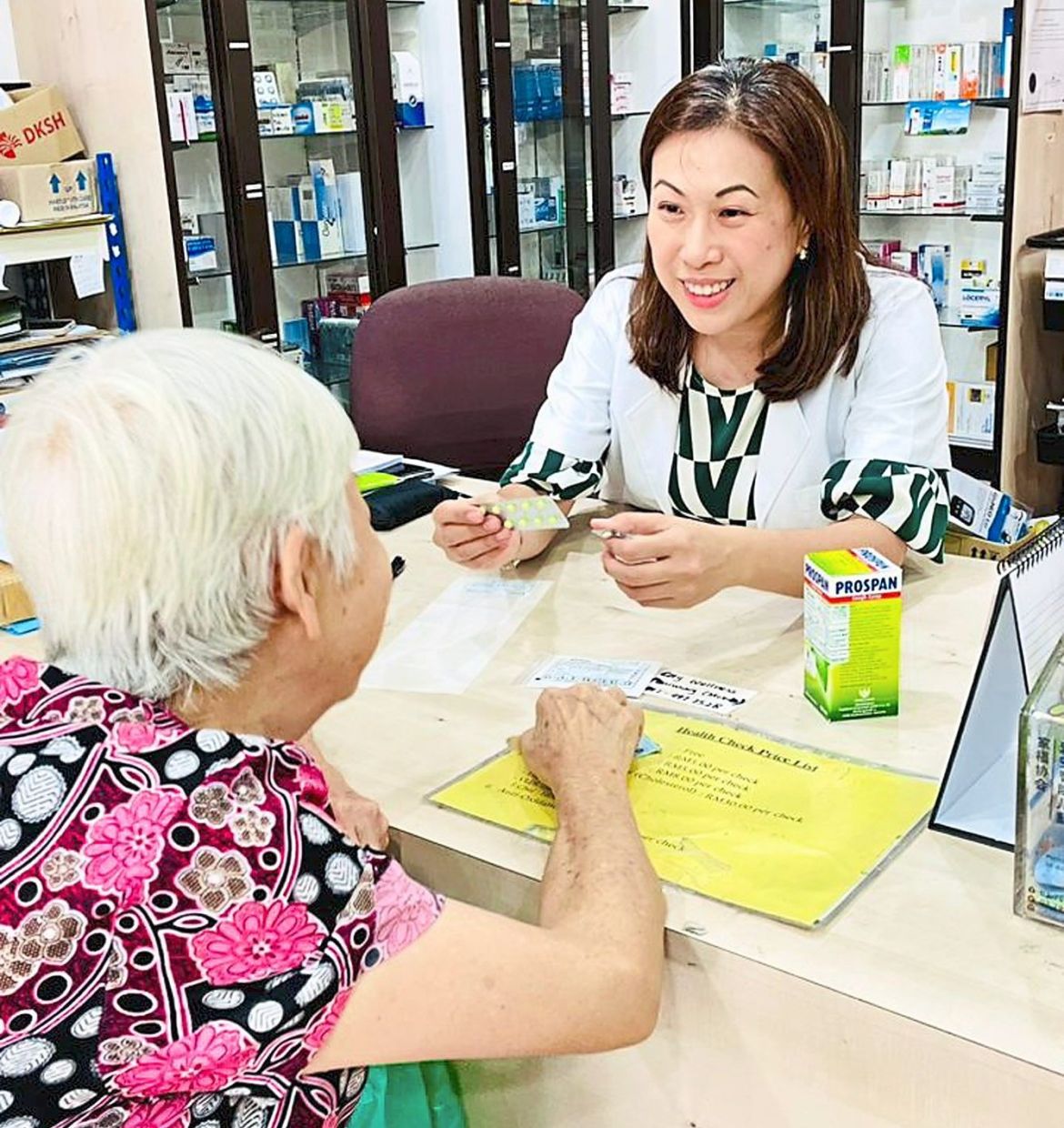
Polypharmacy carries genuine and significant risks, especially for older adults.Community pharmacists are one resource patients can easily access to ensure that their medicine regime is up-to-date and not causing any unnecessary side effects. — FilepicCommunity pharmacists are one resource patients can easily access to ensure that their medicine regime is up-to-date and not causing any unnecessary side effects. — Filepic

Due to slower metabolisms and potentially impaired kidney function, the elderly are more vulnerable to the negative effects of multiple medicines.

Some of the most concerning consequences include emergency hospitalisations due to medicine-related complications, drug interactions that lead to undesirable side effects or reduced effectiveness, and adverse side effects such as dizziness, confusion or gastrointestinal issues.

In addition, when medicines impair alertness or physical coordination, they may contribute to falls, fractures and cognitive decline.

Several studies conducted in Malaysia also show that the majority of older adults do not take their medicines as prescribed.

Polypharmacy has a direct impact on medication adherence, which refers to how well patients follow their prescribed treatment plans.

As the number of prescribed medicines increases, the elderly often struggle with complex dosing schedules, leading to missed or incorrect doses.

This not only compromises treatment outcomes, but also increases the risk of hospitalisations and complications.

To address these, it is essential to provide patient education, simplify medicine regimens, and offer support through technology and caregiver involvement.

Reducing the risks

Healthcare systems around the world are adopting more proactive strategies to ensure the safe and effective use of medicines, especially in light of growing concerns about polypharmacy.

One important strategy is regular medicine reviews.

Patients are encouraged to inform their doctors and pharmacists about all the medicines they are taking, including prescriptions, over-the-counter products and supplements.

This open communication allows more regular medicine reviews, which helps healthcare providers identify medicines that may no longer be necessary or could be potentially harmful.

Another key practice is deprescribing, which involves gradually reducing or stopping medicines that are no longer beneficial.

Medicine reconciliation is also essential.

This process ensures that any changes to a patient’s medicine list, such as during hospital admission, discharge or transfer to a nursing home, are accurate and appropriate.

Technology also plays a helpful role.

Electronic health records can alert healthcare providers to potential interactions or duplicate medicines.

Most importantly, a patient-centred approach is needed.

When patients are involved in decisions about their treatment, it builds trust, improves adherence to medicines and leads to better health outcomes.

The most effective strategies to manage polypharmacy involve active participation from both patients and their caregivers.

Several steps are encouraged to support safe medication use:

  • Maintain an updated medicines list, including over-the-counter products, supplements and herbal remedies.

    Bring this list to every medical appointment.

  • Ask your doctor or pharmacist about the purpose, benefits and possible side effects of each medicine.
  • Inform your doctor or pharmacist when you experience side effects, especially if they are suspected to be caused by a medicine.
  • Get help from pharmacists for medicine reviews, especially after hospital stays or when there is a change in the medicine regimen.
  • Use adherence devices or tools to help take medicines correctly, such as pill boxes, mobile apps or mobile alarms.

The role of pharmacists

As the number of elderly individuals taking multiple medications daily continues to rise, the role of pharmacists has become increasingly vital.

While doctors are responsible for diagnosing conditions and prescribing treatments, pharmacists ensure that medications are used safely, correctly and effectively.

With specialised knowledge in pharmacology and drug interactions, pharmacists are often able to detect issues that may be overlooked by others.

These include overlapping therapies, potentially harmful drug combinations, and unnecessary or duplicate prescriptions.

Community pharmacists, in particular, are in a unique position to support patients directly.

As the most accessible healthcare professionals, they can offer personalised counselling, conduct routine medication reviews and help patients understand the purpose and proper use of each medicine.

They can also identify early signs of adverse effects or non-adherence, and refer patients for further medical attention when necessary.

Addressing polypharmacy requires a coordinated approach that centres on the patient.

As the population grows older, providing safe, effective and individualised treatment is crucial.

Balancing illness management with quality of life is key to delivering better and safer care to older adults.

For any inquiries regarding medicines, please call the National Pharmacy Call Centre (NPCC) at the toll-free number 1-800-88-6722 during weekdays from 8am to 5pm, except on public holidays.

By PAYAL CHOUDHURY

Payal Choudhury is a pharmacist at Hospital Tengku Ampuan Najihah in Kuala Pilah, Negri Sembilan. This article is courtesy of the Health Ministry’s Pharmacy Practice and Development Division.

For more information, email starhealth@thestar.com.my.

The information provided is for educational and communication purposes only, and should not be considered as medical advice.

The Star does not give any warranty on accuracy, completeness, functionality, usefulness or other assurances as to the content appearing in this article. The

Star disclaims all responsibility for any losses, damage to property or personal injury suffered directly or indirectly from reliance on such information.

Source link

Related stories:

Hepatitis: Infections that drive liver disease

Drugs are intended to cure, instead they're becoming water contaminants

Fighting lupus from within with the right drugs

Influencers and celebrities, beware of promoting health products!

HIV patients must take antiretrovirals but there's a downside to these drugs

Juggling Multiple Meds: Doctors and the Ninth Prescription

https://www.linkedin.com/pulse/pills-should-more-than-color-day-alan-pitt-m-d-/

Several years ago, when prescribed a single medication to be taken daily for several months, I found it very difficult to remember to take it every day. I knew it was important and I knew why I was taking it, but even then I forgot. That experience got me thinking about the many people who are asked to take six, seven, ten drugs a day…forever. I have no idea how they remember to take all of these drugs correctly, and the fact is, most people don’t. This was made clear to me as early as my residency, when it was not uncommon for people to bring in garbage bags full of medicines. When asked how they determined which ones to take and when, these patients often seemed to go by the pill color of the day rather than any set schedule or plan. 

In fact, the data on this issue—known as medical compliance—reveal an abysmal record of patients’ taking medications “as prescribed.” Reportedly less than one third of diabetic patients take metformin correctly. And only half the patients with high blood pressure take even 80% of their medications as prescribed. The end result is a multi-billion-dollar expense with unpredictable and often dangerous outcomes. How does this happen? 

Unfortunately, when it comes to prescriptions, providers are required to be compulsive. We are trained not only to address every problem with a solution, but also to do so on an individual basis. If you have asthma, there's a treatment for that. If it’s heart disease, here’s another pill. Diabetes? Take three more. The list grows quickly, adding expense and, more alarmingly, often resulting in untoward drug-drug interactions. It’s gotten so bad you’d be justified in thinking certain providers delusional for even believing the patient could take the list of medications “as prescribed.” Yet, when you talk to physicians about this issue, many simply shrug their shoulders. They’ll tell you they have little choice. The current medical legal climate requires a response to each identified problem.

One solution to this quagmire is personalized medicine, a topic I’ve discussed in prior posts. I should note that personalized medicine means different things to different people, but for many, America's love affair with technology often translates personalized medicine into genomic medicine. Eric Topol wrote extensively about this in his book  Creative Destruction of Medicine, explaining how, through sequencing the genome, doctors will be able to predict how each individual will respond to a particular drug. Equipped with such powerful tools, it’s not hard to imagine a future pharmaceutical industry that could customize medications, rather than simply produce mass quantities that work "well" for the average person. 

Until that particular biotech future arrives, I think there is a far simpler and immediate opportunity open to personalized medicine: by identifying a patient's ability to participate in her own care and then matching the medication regimen not only to her needs and preferences, but to subjective criteria such as mental clarity, alertness, daily routines, family support, etc. Two people with exactly the same list of problems may have very different abilities and willingness to take a complex regimen of medications. A 50-year-old executive may have the same problem list as an 80-year-old nursing home patient, but will clearly have different organizational skills, financial resources as well as an understanding of why the regimen matters. For physicians to write prescriptions they know deep down their patients cannot take borders on the absurd and certainly does not constitute good care. 

Although I'd like to think physicians would read this and suddenly change the way they write prescriptions, I am not that naïve. Without a significant change in how we're trained as well as appropriate protections from medical legal risk, it's unlikely doctors will suddenly change the way they practice. However, you as the patient have an opportunity to ask the questions. Are all of these medicines necessary? And if I only take a portion of the drugs, what is the overall increased risk to my health?  If you find yourself simply unable to follow the regimen, have an honest conversation about alternatives. Remind your doctor that you are not a “problem list” but an individual with specific medical requirements and concerns.

Ultimately, treating problem lists instead of people may be “right" but it's not reasonable. 

Sunday, May 18, 2025

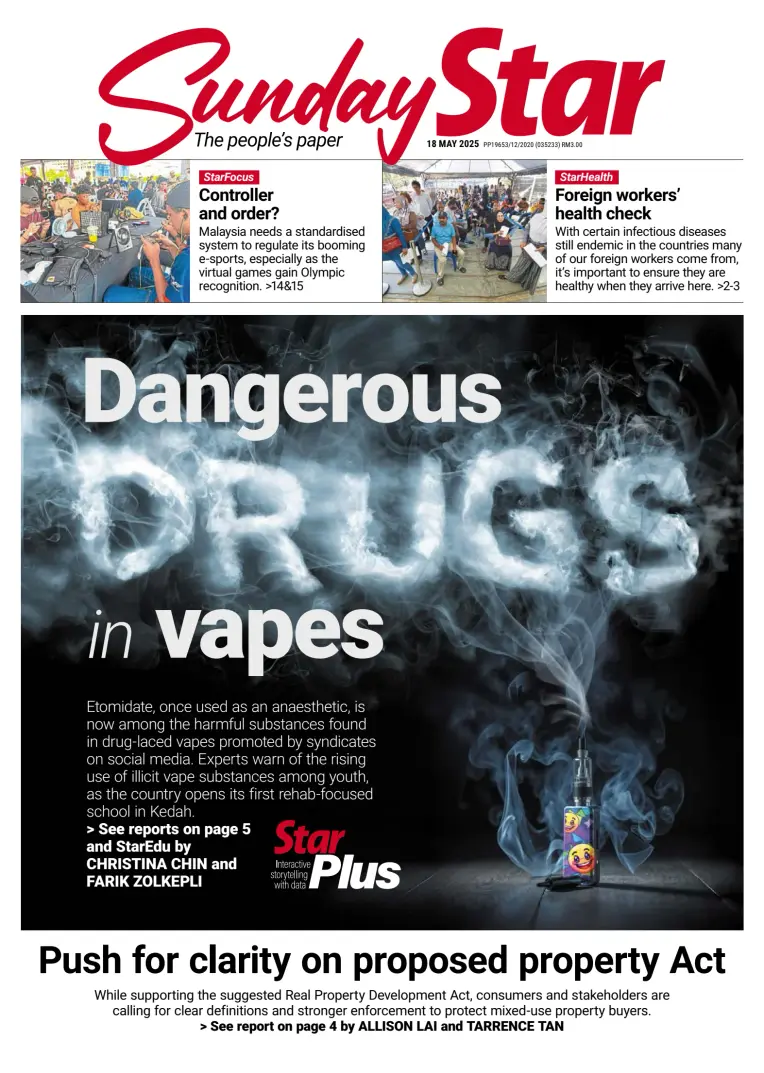
Vaping their way to drugs, dangerous


Pocket size: Widely available, small, colourful vape devices are also easy to conceal. — File photo

A DECADE ago, when e-cigarettes, or vapes, landed on our shores, tobacco cessation experts cautioned that the devices could be a gateway to smoking, and a threat to Malaysia’s goal of becoming a smoke-free nation.

Today, the fear is that vapes are luring teens to drugs, creating a generation addicted to substances even more dangerous than nicotine, Monash University Malaysia associate professor and KPJ Puteri Hospital consultant Dr Anne Yee told StarEdu.

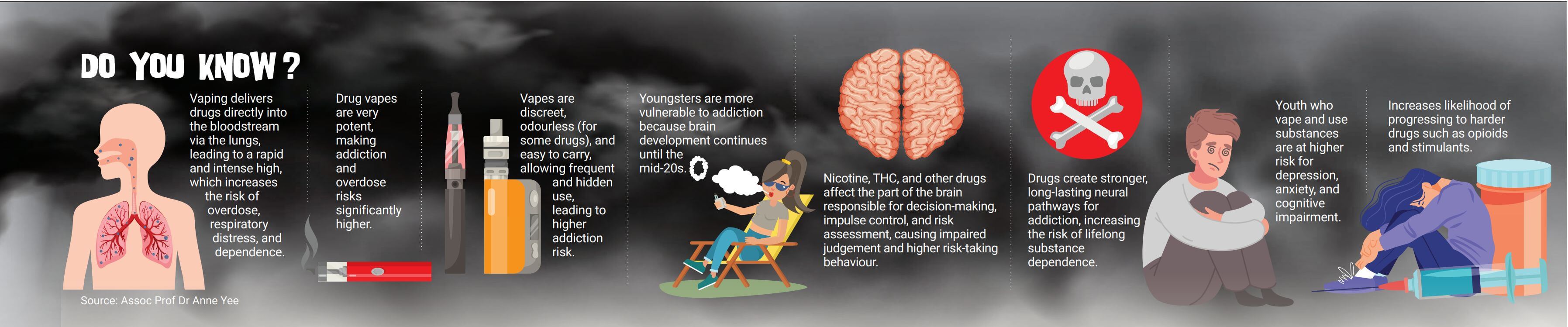
Dr Yee, who is also a Universiti Malaya Centre of Addiction Sciences (UMCAS) adjunct professor and Addiction Medicine Association of Malaysia (AMAM) honorary secretary, said unregulated vape liquids are increasingly being mixed with unknown substances, making them more dangerous and addictive.

Vaping nicotine, Dr Yee noted, increases the likelihood of trying other addictive substances, including cannabis and illicit drugs.

Early exposure to nicotine primes the brain for further drug experimentation​, she said.

“Many vape products contain high levels of nicotine, increasing the risk of long-term addiction.

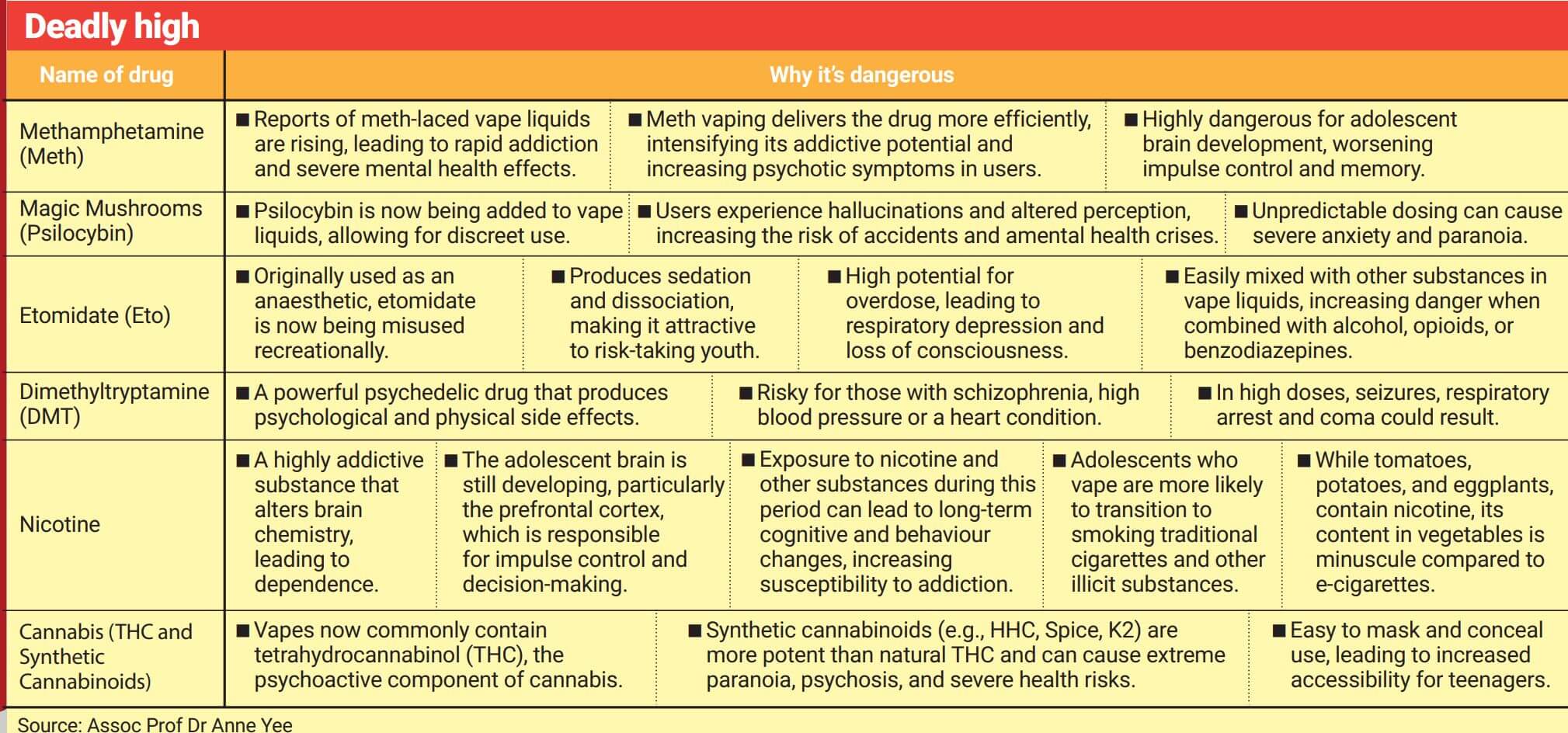
“The earlier a person starts using nicotine, the greater the risk of developing substance use disorders later in life,” she said, adding that vapes have been found to contain illicit substances such as THC, synthetic cannabinoids, or opioids (see infographic), which increase the risk of addiction, toxic chemical exposure, and the risk of respiratory and neurological damage.

“Youths may unknowingly inhale these dangerous substances as unregulated vape products are widely available online – especially social media,” she said.

Narcotic Addiction Rehabilitation Centre (Puspen) Karangan director Zuraidah Ayob said most of the teens at the facility get stuck on drugs through vaping.

“It’s very worrying because the numbers are increasing.

“During one visit to a school in Kuala Lumpur, I asked the 200 students gathered how many of them vaped. A quarter raised their hands. Those were the ones who admitted but imagine how many others who were afraid to raise their hands?” she said, adding that when vape was introduced, it was promoted as a healthier alternative to smoking but the vapour is not safe.

Most vapes contain nicotine levels that are higher than cigarettes, she said.

“Teens are getting hooked without even realising it because they see it as a trend rather than a high risk habit.

“Vape is a gateway to drugs and if not curtailed through education, enforcement and parental or community intervention, we will create a generation that is highly vulnerable to drug abuse,” she concluded.

Note: The Puspen Karangan school is in need of reading materials for its library, as well as volunteers to conduct tuition classes, skills training and motivational talks for its students. Companies interested in assisting as part of their corporate social responsibility programmes, or non-governmental organisations involved in education, may contact the school at zuraidah@aadk.gov.my or pengarah_karangan@aadk.gov.my

CLICK TO ENLARGECLICK TO ENLARGE

CLICK TO ENLARGECLICK TO ENLARGE

‘Mushrooms’ in our midst

Determined to turn over a new leaf, these students will sit for their Sijil Pelajaran Malaysia (SPM) exams this year at the country’s first Puspen school in Karangan, Kedah.

A typical day for these students starts at 9am and ends at 4.30pm. In between lessons at the school, which opened in December last year, co-curricular activities like computer classes are conducted, with students given a two-and-a-half-hour break for lunch.

In an exclusive interview with StarEdu, these students share how curiosity and friends led them to “magic mushrooms”.

Vaping, they say, should be banned because illegal substances are so easily available.

I was introduced to ‘mushrooms’ three years ago by a friend. Before I knew it, I was spending more than RM20 daily to feed my addiction. I got the liquid from a dealer and added it to my vape. The high would hit within five to 10 seconds, and I’d start to feel calm. Soon, I began feeling scared because the drug caused me to overthink. It slowed down my brain, and I was always forgetting stuff. I really regret trying it – if not for my curiosity, I wouln’t be here today. I hope vaping will be banned because many are abusing it. I want to continue my studies if I pass the SPM.

– Salman, 17, Selangor

CLICK TO ENLARGECLICK TO ENLARGEI used to take pil kuda (yaba pill) to give me energy when I worked in the paddy fields. I could not sleep at night so I turned to vaping ‘mushrooms’. I started when I was 13. My friend told me it would help with my insomnia and soon I was hooked. It’s only RM1 per drop and it is very easy to buy. Usually I would buy 10 drops and when I had some money, I would get a bottle for RM150, which could last me a week. It didn’t affect my studies because I was already skipping school anyway, but because I had been playing truant, my school called AADK. I was picked up and my urine test came back positive. It would be good to ban vaping because it is so easy to consume drugs with the device. No one will know. There is no smell at all. Please do not try it because when you are experiencing withdrawal, you really lose all control. I don’t crave it anymore, though sometimes I still have trouble sleeping.

– Kamal, 16, Terengganu

I am here because of ‘mushrooms’ introduced by friends. I was spending about RM700 and above per month on vaping. I come from a well-to-do family. My pocket money was RM40 daily. Sometimes I got more if I helped my mum, so I could save up to RM70 per day. If I had extra, I’d buy a bottle of mushroom liquid, which cost between RM90 and RM150. It’s widely available on social media. The first time I tried it, I thought, “Best le”. I felt happy – always laughing. I tried it for fun and was hooked for three years. I started with a little bit – over time, I felt I couldn’t do without it, so I was vaping 24 hours a day. I needed it as soon as I woke up. It interrupted my studies. I felt ‘heavy’ and couldn’t do anything. Many of my friends used it but I usually vaped alone or with my twin brother. He stopped a little bit earlier than me. I ‘kantoi’ last year during Raya. My mum woke me up on the morning of Raya and asked me to take a bath but I couldn’t wake up. She was angry and started scolding me. My brother came in and saw my vape. He knew what had happened. He asked me if it was ‘mushroom’ but I denied it. He didn’t believe me and tried it. He ended up losing consciousness. He woke up six hours later and couldn’t remember a thing. He told my mum. My mum gave me many chances until finally, the school found out and contacted AADK. Now, I am determined to do my best because in Puspen, the education is good – especially the aspects of religion and discipline. After SPM, I want to be a pilot but I wear specs so that may not be possible. If I can’t achieve what I want, I will continue my mum’s business as taukeh canteen. My first time trying drugs was through vape. It is so cheap and easy to buy. It should be banned. Please don’t be like me. You will ‘gian’ after the first try and it will be hard to stop.

– Adam, 17, Pahang

I don’t even drink alcohol but I started vaping in Form One and was introduced to meth and weed vape liquids. My friend said I would feel high so I wanted to try – 1ml was only RM30. One bottle was RM150. We would pool our money and share one bottle. Usually when I was high, my eyes would turn red but if I took too much, I got sleepy. For the longest time, no one knew. Every 30 minutes I would need to vape. The first time I tried, I felt nothing. And then I got addicted. I’d just spend my days sleeping. For three years, my mum tried to advise me but I couldn’t stop. This year is my SPM year, so she wants me to sit for the exams at Puspen. I am not angry with my mum for sending me here but I am sad. I know it’s for my own good. Now, I feel prepared for my SPM. Every two weeks, my parents will visit. If I could do things all over again, I would never touch this. No more drugs. I didn’t take drugs because of family problems. It was because of friends. I am an only child. My mother cried so many times. I felt so sad because I kept repeating my mistake. Even one drop can change your future. Just don’t try. The negative things that come with one try is not worth it. I want to be a policeman but I am scared that after this, I won’t get a chance. If I cannot join the force, I want to study to be a vet.

– Raghu, 17, Penang

I was always lazy to go to school – ‘kuat ponteng’ since Form Two. I had some issues at home. I got hooked on drugs at 17. It all started with normal vape until my friend introduced me to liquids with drugs. ‘Gian I kuat’ and I couldn’t stop. I couldn’t sleep because there was a lot on my mind. So I would vape before going to sleep. I was working part-time at a food stall. When I vaped, I couldn’t work. I felt lazy. Eventually, my boss found out. I ‘kantoi’ with mum. I was always sleeping and she suspected something was amiss. I used to also pace a lot and could not sit still. I was always dizzy. When my mum asked what’s wrong, I did not tell her. I tried to stop but I kept going back. I used ‘mushroom’ and would spend about RM10 to RM20 a day. I bought it from a friend. I really want to change. I want to get a good job and make my mum happy. When she sent me here, my mum told me to take care of myself and study properly. After my SPM, I want to take up vocational skills – to be an electrician. I am now focused on memorising my lessons for the SPM. School is good so far. I hope youths like me will be more selective when making friends. Avoid people who introduce you to bad things. Stay far, far away because once you start, it’s hard to stop.

– Amin, 19, Kedah

I’m the third of five siblings. When I was in Year One, my parents divorced. I could not accept that my father had remarried. My mum suffered from mental illness. I was Form One when I started vaping ‘mushrooms’. Before that, I was smoking cannabis for five years. Two years ago, my friend let me try ‘mushrooms’ with vape. Then I started using pil kuda together with the mushroom liquid. I had registered to sit for the SPM then but because I was high and hallucinating from ‘mushrooms’, I got into an accident and dropped out of school. I am excited to sit for my SPM this year because I have never been out of my home state. I entered Puspen unprepared but I have tried by best to face it. From my heart, I want to tell students like me – if you have girlfriend problems or whatever, don’t turn to drugs. You don’t need this in your life. I turned to drugs because I was disappointed with my girlfriend and family. When I was high, my family became like my enemy – I was aggressive with my parents. I just wanted money from them. I didn’t realise what I was doing. I would snatch money from my mum when she did not want to give it willingly. I couldn’t control my emotions and now I am here. My family finally put me here because they knew I was hanging out with the wrong crowd. I have been here for 11 months. My body is full of toxins now - pumped with drugs. I am learning to accept that I am an addict. I cannot go home because if I do, I will definitely go back to my friends. After SPM, the first thing I want to do is hug my mum and apologise to her because I spent this Raya without my family. I want to say thank you to my mum for everything and I want to make her proud of me. Even though society will always see the word ‘penagih’ stamped on my forehead, I will always try to make my mother proud – with everything that I have. I understand now my mum is sick, so as a son, I must try to move forward - away from the past hurt, and make her proud.

– Shukri, 19, Terengganu

*Names have been changed to protect the identities of the students.


CLICK TO ENLARGECLICK TO ENLARGE

CLICK TO ENLARGECLICK TO ENLARGE

Source link


Related stories:


15 hours ago — Today, the fear is that vapes are luring teens to drugs, creating a generation addicted to substances way more dangerous than nicotine.
Missing: pressreader ‎| Show results with: pressreader